Everyone arrives in Korea with the same list. Gyeongbokgung Palace. Myeongdong shopping street. Namsan Tower photo. Those places are fine. But after living here and watching thousands of visitors come and go, the things people remember most are rarely on that first list.
This is the version a local would give you. Not the brochure. Not the algorithm. The things actually worth your time.
1. Eat the Food Korea Is Actually Known For
Korea has one of the strongest food cultures in the world — not in the fine dining sense, but in the sense that ordinary people eat extraordinarily well on a daily basis. The meals that have defined Korean food culture for generations are not in hotel restaurants or tourist-facing establishments. They are in small neighborhood spots that have been doing the same thing for decades, with the same regulars sitting at the same tables.
Three dishes in particular are worth understanding before you arrive.
Korean BBQ — The One Everyone Knows, For Good Reason
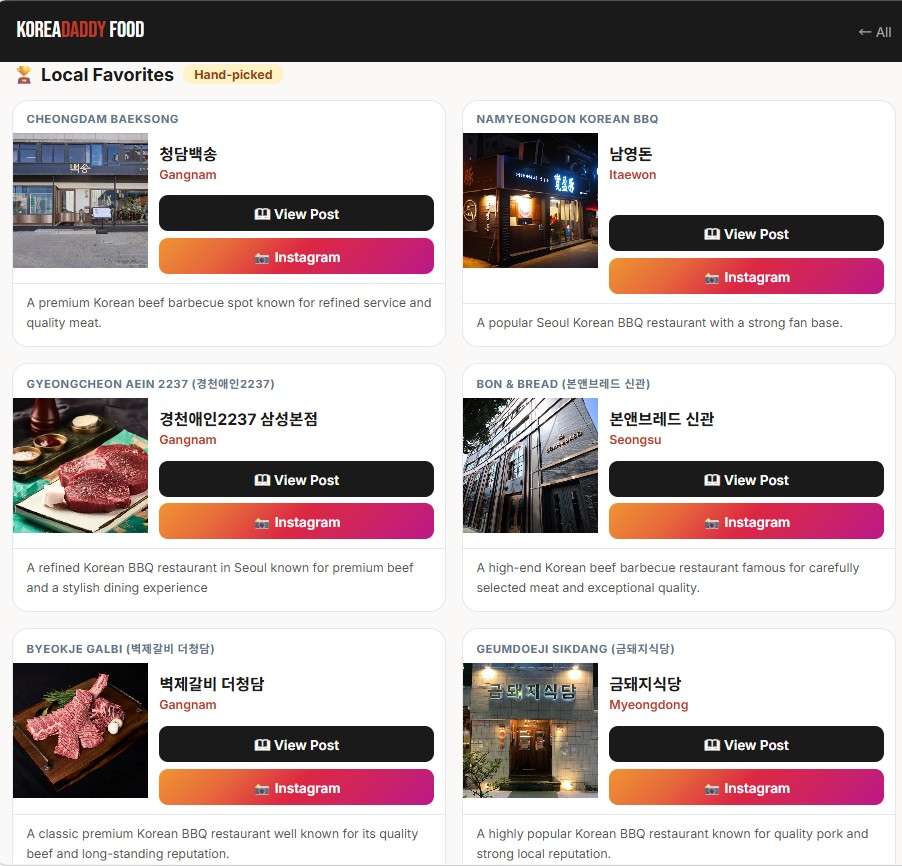
Korean BBQ has been the country’s most recognized food export for decades and the reputation is entirely deserved. The experience — raw meat grilled at a charcoal or gas grill built into the table, eaten immediately, wrapped in lettuce with fermented paste and raw garlic — has not changed in fifty years because it does not need to. It works.
What most visitors do not realize is how wide the quality range is. The BBQ restaurants near Hongdae or Myeongdong that appear in every travel article are convenient but rarely the best. The places that have been consistently full of Korean customers for twenty or thirty years tend to be in quieter neighborhoods, have no English signage, and cost the same or less. The meat quality is usually better and the banchan (side dishes) that come with the meal are made in-house rather than bought from a supplier.
Samgyeopsal (pork belly) is the most popular and the safest starting point. Galbi (beef short ribs) and chadolbaegi (thin beef brisket) are the cuts worth trying once you are comfortable with the format. A full meal for two with soju runs ₩30,000 to ₩50,000 at a good local restaurant.
Jokbal — The Late-Night Staple That Tourists Keep Discovering
Jokbal — slow-braised pig’s trotters seasoned with soy sauce, ginger, and garlic — has been a Korean late-night staple for as long as anyone can remember. For years it was considered working-class comfort food, the kind of thing eaten after a long shift or late into the night at a pojangmacha tent with bottles of soju. Recently something shifted. Food media caught up with what Koreans already knew, and jokbal has gone from overlooked to one of the most talked-about Korean dishes among food-focused visitors.
The texture surprises people. It is not what you expect from pig’s trotters — the slow braising process renders the fat into something almost silky, and the collagen content is high enough that the meat holds together in clean slices. Eaten cold with shrimp paste (새우젓) and wrapped in perilla leaf, it is one of the more genuinely interesting flavor combinations in Korean food. Eaten hot, directly from the pot with naengmyeon (cold buckwheat noodles) on the side, it is one of the best late-night meals in the country.
The neighborhoods historically associated with jokbal — Jangchungdong in central Seoul, certain streets in Mapo — still have clusters of restaurants that have been operating in the same spot for thirty or forty years. These are not trendy. They are just very good at one thing.
Gopchang — What the Locals Order When They Really Want to Eat
Gopchang — grilled beef or pork intestines — is not a dish that markets itself. There are no pictures of it on the covers of travel magazines and it does not photograph particularly well. What it has instead is a devoted following among people who actually know Korean food, and a reputation among locals as the thing you order when you want to eat seriously rather than conveniently.
The flavor is rich and deeply savory in a way that is difficult to describe accurately — somewhere between the smokiness of good BBQ and the intensity of well-aged offal, without the challenging qualities that put people off offal in other contexts. The key is freshness. Gopchang deteriorates quickly and the best restaurants receive their supply daily and sell out before closing. The places that have been doing this for decades know exactly what they are working with.
It is not for everyone. But for the visitors who try it at a proper neighborhood spot — usually loud, usually late at night, usually with soju — it tends to become the meal they talk about most when they get home.
2. Spend a Night at a Jjimjilbang
A jjimjilbang is a Korean bathhouse and sauna complex. You pay around ₩12,000 to ₩15,000 at the door and get access to gender-separated hot bath pools in different temperatures, multiple dry and steam saunas, and a large common rest area where men, women, and children all coexist in matching shorts and t-shirts provided by the facility. Many are open 24 hours. Staying overnight costs the same entry price — you sleep on the heated floor of the common area on a thin mat alongside everyone else.
The sequence that works: soak in the hot pool for twenty minutes, move to the dry sauna, drink cold water, repeat. By the second hour your body will have fully let go of whatever tension it was holding. Koreans of all ages use jjimjilbangs regularly — this is not a tourist activity, it is a functioning part of daily life here, and you will be the only foreigner in most of them.
Eat the hard-boiled eggs and sikhye (cold sweet rice drink) from the vending machine. This is mandatory.
3. Take a Day Trip Out of Seoul
Seoul is excellent but Korea is more than Seoul, and the KTX high-speed train makes the rest of the country genuinely accessible. Gyeongju is the old Silla capital — the entire city is essentially an open-air museum with royal tombs sitting in the middle of residential neighborhoods. Jeonju has the best traditional food in Korea and a hanok village that has not been turned entirely into cafes yet. Suwon has a complete Joseon-era fortress wall you can walk the full circuit of in two hours.
Each of these is a full day from Seoul and back. None of them requires planning more than a KTX ticket bought the night before.
4. Ride a Bike Along the Han River
The Han River runs through the middle of Seoul with flat, well-maintained cycling paths on both banks running for kilometers without a single traffic light. Rent a bike at Yeouido Park, Banpo, or Ttukseom for around ₩3,000 per hour. On weekend afternoons Koreans bring entire meals in coolers and set up on the grass by the water. There is a particular quality of light on the Han River in the late afternoon that is difficult to describe and worth experiencing once.
5. Do a Temple Stay
Korea’s Buddhist temples offer structured overnight programs for foreigners throughout the year. The schedule is early — the morning bell rings at 4am — and the experience includes communal silence, a walking meditation, a simple vegetarian meal eaten in a specific ritualized way, and tea with one of the resident monks. The accommodation is a bare room with floor bedding.
People who do this tend to describe it as the most unexpectedly meaningful thing they did in Korea. The official booking platform is templestay.com and operates in English. Overnight programs run around ₩70,000 to ₩100,000.
6. Get a Health Checkup
This one surprises people but it is increasingly common among visitors who time a Korea trip around a medical checkup they simply cannot afford at home. Korea’s healthcare system is world-class. Clinics in Seoul operate specifically for international patients with English-speaking coordinators, transparent pricing published in advance, and comprehensive packages — full blood panel, imaging, physical exam, consultation — at a fraction of what the same would cost in the US, UK, or Australia.
It is not medical tourism in the exotic sense. It is just good medicine at a fair price, available to anyone who shows up.
7. Walk Through a Real Market
Korea’s traditional markets are still functioning daily commerce, not preserved attractions. Gwangjang Market in Seoul is the most visited and justifiably so — the bindaetteok (mung bean pancakes) fried fresh at open stalls and the mayak kimbap (small sesame rice rolls) have been made the same way for decades. Go in the morning when the food is freshest and the crowd is mostly Korean grandmothers doing their weekly shopping.
If you are in Busan, Gukje Market is better — larger, less curated, and still a place where actual commerce happens rather than a performance of it.
8. Sleep on an Ondol Floor
Traditional Korean rooms are heated from beneath. The floor itself is warm, and Koreans historically slept directly on it on thin cotton mats. Modern Korean apartments still use underfloor heating as the primary system. Staying in a hanok guesthouse or any traditional-style accommodation where you sleep on the floor rather than a bed is a genuinely different physical experience — the warmth comes up from below, your back releases, and most people sleep better than they expected.
It feels strange for about ten minutes. After that it feels obvious.
9. Visit Jeju Island
Korea’s southern island is a different country in feel. Volcanic landscape, a dialect the mainland can barely understand, a matriarchal fishing culture built around the haenyeo — women who free-dive to harvest seafood without equipment, some of them into their seventies and eighties. The haenyeo are UNESCO-listed and still active. You can watch them come ashore at the smaller coastal villages in the east of the island.
Fly from Gimpo Airport in Seoul. The flight is 55 minutes and cheap if booked a week ahead. The Olle Trail — a coastal walking route that circumnavigates the island in sections — is genuinely world-class hiking.
10. Use Korea’s Medical Tradition
Hanbang — Korean traditional medicine — is not alternative medicine in the fringe sense. It is a parallel medical system with licensed practitioners, regulated clinics, and insurance coverage in Korea. A consultation with a hanbang doctor typically involves pulse diagnosis, a detailed discussion of symptoms and constitution, and a prescription of herbal medicine compounded specifically for you. The experience is thorough and the practitioners are highly trained.
For visitors, it is worth doing once for the experience alone. For those with chronic conditions that Western medicine has not resolved, several clinics in Seoul specialize in treating foreign patients.
The Things That Make It Easier
A few practical things most travel articles do not explain clearly enough: exchange currency at the Myeongdong money changers or Dongdaemun, not at the airport — the rate difference adds up. Download Kakao Maps rather than relying on Google Maps, which misses smaller restaurants and shows incorrect hours. Korean pharmacies (약국) are excellent and accessible — staff will help with basic symptoms over the counter without a prescription and the prices are low.
Check K-ETA requirements before you travel — entry rules for Korea changed in 2026 and several nationalities that previously entered visa-free now need prior authorization.
The Short Version
Korea rewards the people who get off the main tourist circuit quickly. The food is better two streets from the landmark. The transport is excellent once you stop fighting it and learn the system. The cultural experiences that feel most foreign at first — the bathhouse, the floor sleeping, the 4am temple bell — are the ones people talk about for years afterward.
Come with less of a plan than you think you need. Korea will fill the gaps itself.