Quick Answer
- Most popular cut: Samgyeopsal (삼겹살) — pork belly, ₩15,000–₩20,000 per portion
- You grill it yourself — staff will help if needed but it’s expected you do it
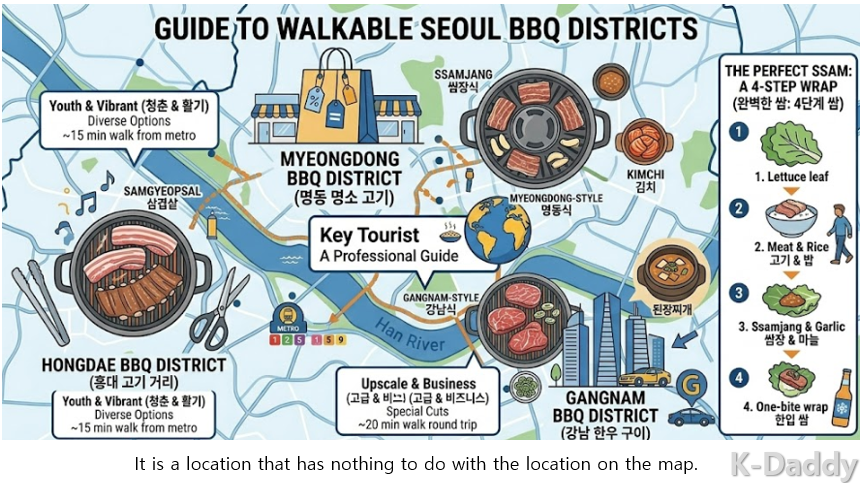
- Wrap in lettuce with rice, garlic, and ssamjang paste — eat in one bite
- Side dishes: Free, refillable, eat them alongside the meat
Korean BBQ looks intimidating the first time. There’s a grill in the middle of the table, raw meat arrives, and everyone around you seems to know exactly what they’re doing. Here’s what’s actually happening and how to do it right. This korean bbq guide for beginners covers everything you need — what to order, how to grill it, how to eat the wrap, and what all the side dishes are for.
Types of Korean BBQ Restaurants
Self-grill (직접 구워 드세요): Most common — you grill everything yourself. Staff will help if you look stuck but the expectation is that you manage the grill. This is what most restaurants visited by foreigners are.
Staff-grilled (직원이 구워드립니다): Higher-end restaurants where staff grill for you. More expensive, more attentive service. Good for a special occasion.
All-you-can-eat (무한리필): Fixed price, unlimited meat. Quality is usually lower than à la carte but value is good. Common near universities. Around ₩15,000–₩25,000 per person.
What to Order — The Most Common Cuts
Samgyeopsal (삼겹살) — Pork Belly
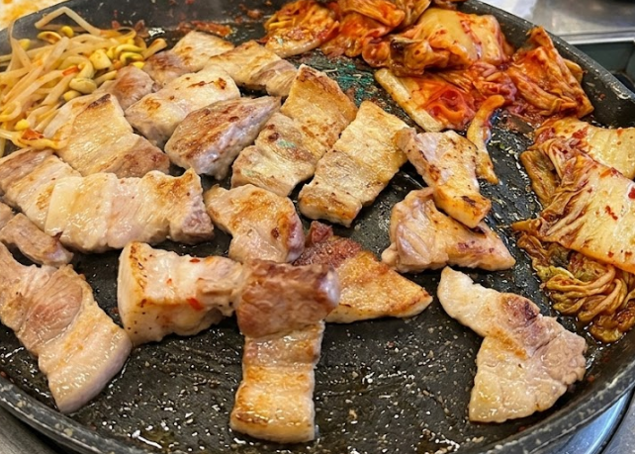
The most popular Korean BBQ option. Thick-cut pork belly grilled until the fat renders and the edges crisp. Rich, satisfying, and forgiving to grill — it tells you when it’s ready by changing color and shrinking slightly. The right first choice.
Chadolbaegi (차돌박이) — Beef Brisket
Thin-sliced beef brisket. Cooks in about 30 seconds per side — the fastest option at the table. Lighter than pork belly, slightly more expensive. Order one of each if you want variety.
Galbi (갈비) — Marinated Short Ribs
Beef or pork short ribs marinated in soy sauce, garlic, and pear. The marinade caramelizes on the grill and adds real flavor. More expensive than samgyeopsal — ₩25,000–₩40,000 per portion — but worth ordering once.
Bulgogi (불고기) — Marinated Beef
Thinly sliced marinated beef with a slightly sweet flavor. The most approachable cut for first-timers in terms of taste. Sometimes grilled, sometimes cooked in a pan insert on the table.
Dwaeji Galbi (돼지갈비) — Pork Ribs
Marinated pork ribs — cheaper than beef galbi with similar flavor depth. Less well-known internationally but a good choice if you want the marinade experience at a lower price point.
How to Grill — Step by Step
- Staff will light the grill and may place the first pieces on. After that, it’s yours.
- Place meat on the grill — don’t overlap pieces, give each one direct contact with the heat.
- Samgyeopsal: flip when the bottom half has turned from pink to white/grey — about 3–4 minutes. Flip once more after 2–3 minutes. Done when lightly charred at the edges.
- Use the scissors (가위) on the table to cut larger pieces into bite-sized pieces while they’re still on the grill. This is normal and expected — not rude.
- Move cooked pieces to the edge of the grill to stay warm without overcooking while you grill the next batch.
- Staff will change the grill grate partway through — let them do it, it’s their job.
Daddy’s Note: The garlic slices on the table go on the grill too — not just in the wrap. Grilled garlic alongside samgyeopsal is one of those combinations that’s hard to explain but impossible to forget.
How to Eat It — The Wrap (쌈)
- Take a perilla leaf or lettuce leaf in your palm
- Add a small amount of rice
- Place a piece of grilled meat on top
- Add a small dab of ssamjang (dark, thick fermented paste) and a slice of raw or grilled garlic
- Fold the leaf around everything and eat in one bite
The one-bite approach is not a strict rule but it’s how the flavors were designed to work together. A half-eaten wrap that falls apart is the alternative — you’ll understand the logic immediately.
The Side Dishes (Banchan)
The small dishes that arrive before the meat are banchan — free, refillable, and meant to be eaten alongside the grilled meat, not before it. You can ask for more of any dish you finish. Nobody will judge you for asking three times.
Kimchi is the essential pairing with pork belly — the acidity and fermented funk cuts through the fat perfectly. If a restaurant’s kimchi is good, it’s usually a good restaurant.
Doenjang jjigae (된장찌개) — soybean paste stew — often comes with the meal or can be ordered separately. It arrives with rice and rounds out what is otherwise a very meat-focused meal. Worth ordering.
Drinks at Korean BBQ
Soju and beer are the standard pairing. Somaek (소맥) — soju mixed into beer — is how most Koreans drink at BBQ. The ratio matters to Korean drinkers; your server can show you if you’re curious.
Not drinking? Sikhye (sweet rice drink) or barley tea are always available and pair well with grilled meat. Korean restaurants never pressure alcohol on non-drinkers.
Price Guide
| Cut | Price per Portion | Notes |
|---|---|---|
| Samgyeopsal (삼겹살) | ₩15,000–₩20,000 | Most popular, pork belly |
| Chadolbaegi (차돌박이) | ₩18,000–₩25,000 | Beef brisket, cooks fast |
| Dwaeji Galbi (돼지갈비) | ₩18,000–₩25,000 | Marinated pork ribs |
| Bulgogi (불고기) | ₩18,000–₩25,000 | Sweet marinated beef |
| Galbi (갈비) | ₩25,000–₩40,000 | Beef short ribs, premium |
Etiquette
- Grill for others at the table — not just yourself
- Pour drinks for others before filling your own glass
- If dining with Korean hosts, the eldest person typically eats first — a brief pause before starting is polite
- Don’t stick chopsticks upright in rice — this resembles funeral ritual offerings
- Receiving food or drinks with two hands, or with one hand supporting the wrist, is a sign of respect
Ordering Without Korean
Point at the menu item and hold up fingers for portions. Most Korean BBQ restaurants have photo menus. “Igeo juseyo” (이거 주세요) means “this one please” — point as you say it. This works in every BBQ restaurant in Korea.
Where to Find a Good One
Mapo-gu in Seoul — near Mapo Station, Lines 5 and 6 — is considered one of the best areas for samgyeopsal. A concentration of pork-focused restaurants that have been operating for decades. Avoid restaurants with menus in six languages right at the entrance of tourist streets — these rely on foot traffic, not quality.
A queue of Korean customers on a weeknight is the most reliable indicator of a good restaurant. Ask your accommodation host for a recommendation — this gets better results than any app.
Lunch vs Dinner
Lunch sets at Korean BBQ restaurants are significantly cheaper than dinner — the same food for 20–30% less. If budget is a consideration, go for lunch. You’ll also avoid the evening crowds and have more room at the grill.
Daddy’s Final Tips
- Go hungry — one portion per person is never enough
- Grill the garlic — don’t skip this
- Order doenjang jjigae to round out the meal
- Lunch is cheaper than dinner for the same food
- Ask your guesthouse or hotel for a local recommendation over using a tourist app