Quick Answer
- Pharmacy sign: 약국 — green cross, found everywhere
- No Korean needed: Point at what hurts or use Papago camera
- Consultation: Free at any pharmacy
- Most medicines: No prescription needed, very affordable
Getting sick while traveling is annoying. In Korea it doesn’t have to be a big deal. Korean pharmacies are genuinely useful — pharmacists are knowledgeable, consultations are free, and medication is effective and cheap. For most common travel ailments, the pharmacy is all you need before considering a clinic.
This korea pharmacy guide covers everything you need when you get sick in Korea — what to buy, how to communicate symptoms, and when to go to a clinic instead.
How to Find a Pharmacy
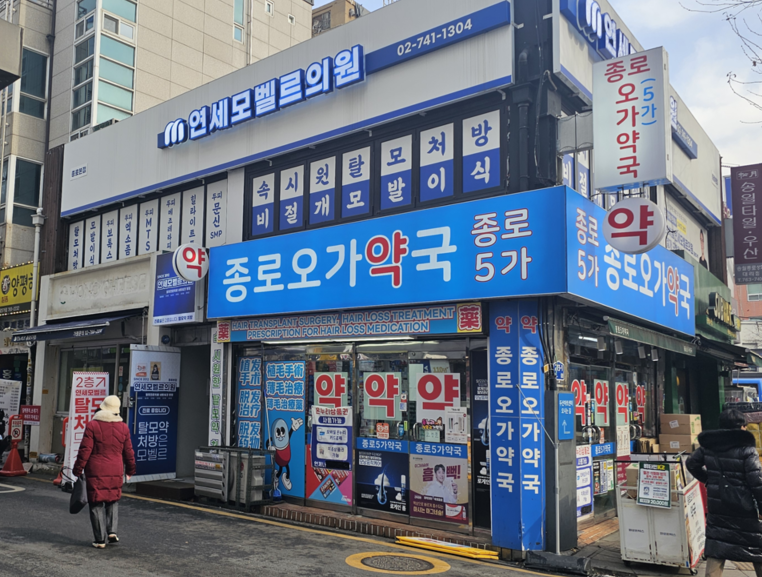
Look for the 약국 sign — usually a green cross on a white background. They’re everywhere in Korean cities. Most are open until 9 or 10 PM. Some near hospitals operate 24 hours.
Naver Map search: type “pharmacy” or “약국” and it shows all nearby options with hours. If you’re in a tourist area, there’s almost certainly one within a 5-minute walk.
You don’t need to speak Korean. Point at what hurts, show your symptom on your phone using Papago’s camera function, or write it in English — Korean pharmacists in tourist areas deal with foreign visitors regularly and find a way to communicate.
What to Buy for Common Problems
Cold and Flu
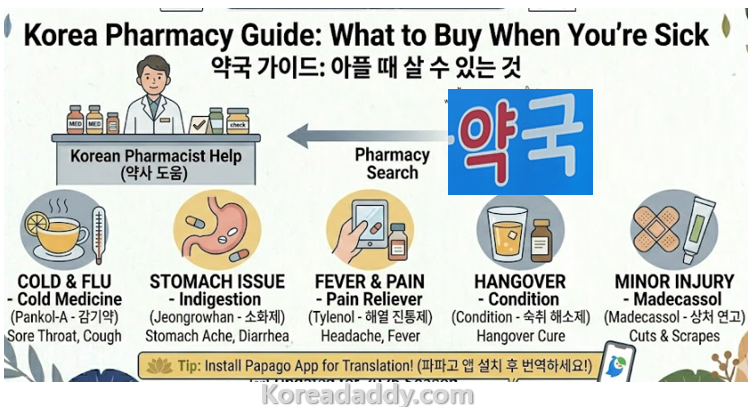
판콜에이 (Pankol-A) or 화이투벤 (Whitetuben) — Korea’s standard cold medicine. Decongestant, antihistamine, and pain reliever combined in one pack. No prescription needed. Around ₩3,000–₩5,000. These are what most Koreans reach for at the first sign of a cold.
Sore Throat
스트렙실 (Strepsils) throat lozenges are widely available. For more serious throat pain, ask the pharmacist — they’ll often recommend a combination of lozenges and a spray. Korean pharmacists tend to give you a complete solution rather than just one product.
Stomach Issues and Diarrhea
정로환 (Jeongrowhan) — small black pills, been around for decades, works well for general stomach upset and mild diarrhea. Around ₩3,000. For more serious cases ask for 스멕타 (Smecta) — a powder you mix with water, effective for acute diarrhea. ₩5,000–₩8,000.
If you suspect food poisoning beyond basic stomach upset, go to a clinic rather than self-medicating.
Fever and Pain
타이레놀 (Tylenol) — paracetamol, available over the counter everywhere, no prescription needed. Alternatively 부루펜 (Brufen) — ibuprofen, same availability. Both are significantly cheaper than back home. Take as labeled on the package.
Muscle Pain and Sprains
제일파스 (Jeil Pas) or 신신파스 (Shinsin Pas) — Korean medicated patches for muscle pain, sprains, and joint aches. These are excellent and much cheaper than equivalent products abroad. Stick directly to the affected area. Available in hot and cool varieties — cool for acute injury, warm for chronic muscle ache.
Hangover
컨디션 (Condition) and 모닝케어 (Morning Care) — small bottles you drink before or after. Around ₩3,000. Available at pharmacies and convenience stores. Whether they work is debatable but Koreans use them seriously. If you’re going to drink heavily, they’re worth having.
Cuts and Minor Injuries
마데카솔 (Madecassol) — Korea’s standard wound healing cream, genuinely good. Apply to cuts and grazes after cleaning. 대일밴드 (Daeir Band) for bandages and plasters. Basic first aid supplies are all available without prescription and cheaper than international equivalents.
Allergies
지르텍 (Zyrtec) — cetirizine antihistamine, available over the counter without prescription. Much cheaper than in Western countries. For severe allergic reactions, go to a clinic or emergency room — don’t rely on antihistamines alone.
Motion Sickness
키미테 (Kymite) patches — worn behind the ear, effective for motion sickness on long bus or boat trips. Available without prescription. If you’re planning ferry trips to Korean islands or long mountain road journeys, worth picking up in advance.
Useful Phrases at the Pharmacy
| Symptom | Korean | Pronunciation |
|---|---|---|
| I have a cold | 감기에 걸렸어요 | gamgi-e geollyeosseoyo |
| My stomach hurts | 배가 아파요 | baega apayo |
| I have a fever | 열이 나요 | yeori nayo |
| I have diarrhea | 설사해요 | seolsa haeyo |
| I have a headache | 머리가 아파요 | meori-ga apayo |
| I have a sore throat | 목이 아파요 | mogi apayo |
| I feel nauseous | 메스꺼워요 | meseukkeowoyo |
| I have a rash | 두드러기가 났어요 | dudeureogi-ga nasseoyo |
Prescription vs Over-the-Counter
Most medications travelers need are available without prescription in Korea — cold medicine, pain relief, stomach remedies, antihistamines, wound care. Antibiotics require a prescription from a clinic. If a pharmacist tells you something requires a prescription, they’re not being difficult — go to the nearest clinic, get the prescription (usually a 10-minute process), and return to the pharmacy.
How Korean Pharmacies Work
Korean pharmacists often package your medication in small labeled envelopes with the dosage and timing written on them — morning/afternoon/evening doses separated and labeled. This is standard practice, not a special service. Follow the dosage instructions on the envelope.
Consultations are free. If you describe your symptoms, the pharmacist will typically recommend a combination of products rather than just one — this is normal and the combination usually works well together.
When the Pharmacy Is Not Enough
The korea pharmacy guide rule: go to a clinic for anything beyond common ailments. Go to a clinic (의원, uiwon) for anything beyond common ailments — high fever that won’t break after 48 hours, chest pain, difficulty breathing, serious injury, suspected infection, or any symptom you’d see a doctor for at home.
A basic clinic visit in Korea costs ₩10,000–₩30,000 including consultation and medication. Bring your passport. The process is efficient — most visits including waiting time take under an hour.
Major hospitals with English-speaking international patient centers in Seoul:
- Seoul National University Hospital — Jongno-gu
- Samsung Medical Center — Gangnam-gu
- Severance Hospital (Yonsei) — Seodaemun-gu
- Asan Medical Center — Songpa-gu
The Korea Tourism Hotline 1330 operates 24 hours in English and can direct you to the nearest appropriate medical facility and provide basic translation assistance. Save this number before you need it.
Travel Insurance and Medical Costs
A pharmacy visit costs ₩5,000–₩15,000 for most common ailments — pay out of pocket and skip the insurance claim for small amounts. Keep receipts for anything over ₩50,000 in case your travel insurance covers medical expenses. For clinic visits and hospital treatment, insurance becomes more relevant — see if your policy covers Korean medical expenses before you travel.
Daddy’s Note
The pharmacy is always the first stop for anything minor. Korean pharmacists are genuinely helpful and the medication works. I’ve sent every visiting friend there for everything from jet lag headaches to dodgy stomach from street food. It handles 90% of situations quickly and cheaply. Save the clinic for when the pharmacy isn’t enough.