Quick Answer
- Honest assessment: Vegetarian is manageable. Vegan is genuinely difficult.
- Biggest hidden issue: Fish sauce and anchovy stock in dishes that look vegetarian
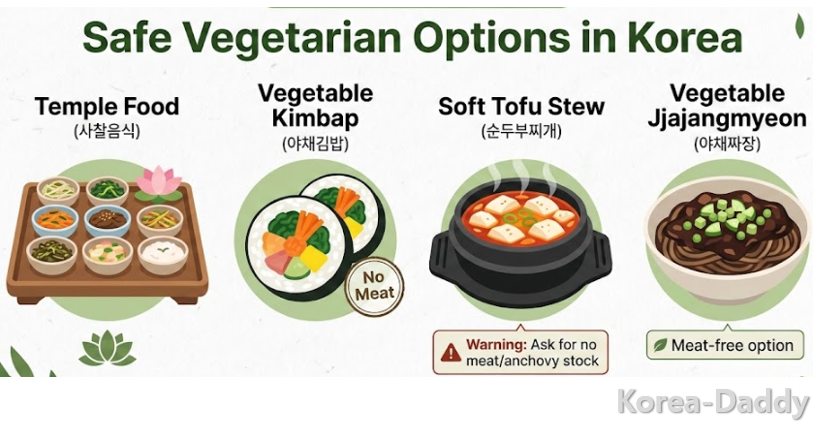
- Safe options: Bibimbap (without meat), vegetable kimbap, temple food, tofu dishes
- Best app: HappyCow for finding vegetarian and vegan restaurants
Korea is not an easy country for strict vegetarians or vegans. Korean cooking uses fish sauce, anchovy stock, and shellfish paste as flavor bases in many dishes that appear vegetarian. Even kimchi traditionally contains fermented seafood. That said, it’s absolutely manageable if you know what to look for.
This vegetarian vegan guide korea covers everything you need to eat well without meat — including the hidden seafood ingredients most visitors don’t expect.
The Hidden Meat Problem
These dishes look vegetarian but often aren’t:
- Kimchi: Usually contains fermented shrimp or fish sauce — vegan kimchi exists but isn’t the default
- Doenjang jjigae (soybean paste stew): Often made with anchovy stock base
- Bibimbap: The rice and vegetables are fine — the sauce sometimes contains meat, and the dish often comes with a meat topping you can request to leave out
- Japchae (glass noodles): Usually contains beef — can be made without, but ask in advance
- Namul vegetable side dishes: Sometimes seasoned with fish sauce or anchovy stock
- Tteokguk (rice cake soup): Almost always made with beef or chicken broth
Safe Vegetarian Options
Temple Food (사찰음식)
Korean Buddhist temple cuisine is strictly plant-based — no meat, fish, or even strong-smelling vegetables like garlic and onions. Temple food restaurants exist in major cities and offer some of the most refined vegetarian cooking in Korea. Slightly more expensive but genuinely excellent and worth experiencing even if you’re not vegetarian.
Temple food restaurants in Seoul:
- Balwoo Gongyang (발우공양): Inside Jogyesa Temple complex, Insadong area. Upscale temple cuisine, reservation recommended.
- Sanchon (산촌): Insadong, long-running temple food restaurant with fixed course menus.
Vegetable Kimbap (야채김밥)
Rice rolls filled with pickled vegetables, spinach, carrot, and egg. Available at every kimbap restaurant and many convenience stores. Ask for “야채김밥” (yachae kimbap). Around ₩3,000–₩4,000 — one of the most reliably safe and affordable vegetarian options in Korea.
Sundubu Jjigae (순두부찌개) — Soft Tofu Stew
Order without meat — “고기 빼주세요” (goegi bbae juseyo). The base broth may still contain anchovy stock depending on the restaurant. For strict vegetarians: “멸치 육수 쓰세요?” (Do you use anchovy stock?)
Jjajangmyeon (짜장면) — Black Bean Noodles
The sauce is soybean-based and meat is an addition, not the base. Ask for vegetable jjajang (야채 짜장). Available at Korean Chinese restaurants everywhere. Most will make it without meat on request.
Dubu Jorim (두부조림) — Braised Tofu
Spicy braised tofu — a genuinely good dish that is vegetarian in most preparations. Available at Korean home-style (백반) restaurants. Not always on tourist menus but worth asking for at local spots.
Convenience Store Options
Korean convenience stores (GS25, CU, 7-Eleven) carry vegetable kimbap, onigiri with non-meat fillings, plain rice balls, instant cup noodles (some vegetarian varieties), and packaged tofu. Not exciting eating but reliable fallback options when nothing else is available.
Vegetarian-Friendly Restaurant Chains
Loving Hut (러빙헛): Vegan Korean restaurant chain with multiple Seoul locations. Full Korean menu — bibimbap, kimbap, stews — made without animal products. Prices similar to regular Korean restaurants. Find locations at lovinghut.co.kr.
PLANT (이태원): Vegan restaurant in Itaewon with an international menu. Popular with expats and foreign visitors. More expensive than standard Korean options but fully vegan and clearly labeled.
Useful Korean Phrases
| Phrase | Korean | Use |
|---|---|---|
| I don’t eat meat | 저는 고기를 안 먹어요 | General statement |
| No meat please | 고기 빼주세요 | When ordering |
| Do you have vegetarian food? | 채식 메뉴 있어요? | Asking staff |
| No fish sauce | 액젓 빼주세요 | Strict vegetarian |
| Do you use anchovy stock? | 멸치 육수 쓰세요? | Checking broth |
| I am vegan | 저는 비건이에요 | General statement |
| No eggs | 달걀 빼주세요 | Strict vegan |
| No dairy | 유제품 빼주세요 | Strict vegan |
Navigating Korean Menus
Most Korean restaurant menus don’t label vegetarian or vegan options. The practical approach:
- Use HappyCow to find vegetarian-friendly restaurants near you before heading out
- For regular Korean restaurants, use Papago camera function pointed at the menu for real-time translation
- Ask the specific questions above about stock and sauce — not just “is this vegetarian?”
- At Korean Chinese restaurants, vegetable-only versions of most dishes are standard accommodations
Supermarket and Self-Catering
Emart, Lotte Mart, and Homeplus all have good produce sections and growing plant-based selections. Korean tofu (두부) is cheap, high quality, and available everywhere — firm tofu for cooking, soft silken tofu for soups. Korean supermarkets also sell prepared vegetable side dishes (namul) in the deli section — check ingredient labels, but many are vegan.
If your accommodation has a kitchen, self-catering gives you full control and access to excellent fresh produce at low cost.
Jeju Island — Easier Than Mainland
Jeju has a stronger vegetarian restaurant culture than mainland Korea, partly due to its international tourism base. If your itinerary includes Jeju, the vegetarian options are noticeably better than average — more restaurants clearly label vegetarian dishes and vegan options are more common.
Best Resources
- HappyCow app: Most reliable for finding verified vegetarian and vegan restaurants in Korea — filter by city, check reviews from other vegetarian travelers
- Loving Hut chain: Vegan Korean food, multiple Seoul locations
- Insadong area: Highest concentration of vegetarian-friendly restaurants in central Seoul, largely due to proximity to temple culture
Daddy’s Honest Take
If you’re vegetarian for health reasons and don’t mind occasional trace amounts of fish sauce, Korea is very manageable. You’ll eat well. If you’re strictly vegan for ethical reasons, you’ll need to research each meal and ask specific questions — but it’s absolutely doable with preparation.
The temple food experience alone is worth the extra effort. It’s not a compromise option — it’s one of the most interesting food experiences Korea offers, and it happens to be entirely plant-based.