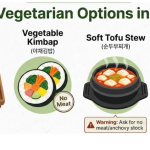
Quick Answer
- Most restaurants: Have photo menus — point and order
- Many restaurants: Use touchscreen kiosks — visual, no Korean needed
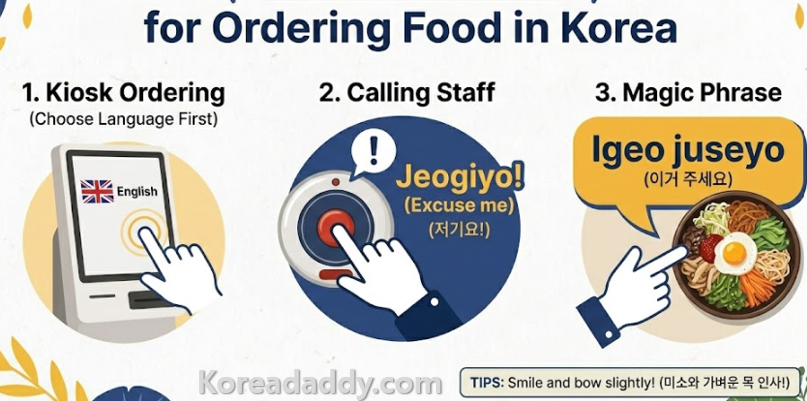
- Key phrase: “이거 주세요” (igeo juseyo) — “this one please”
- Translation app: Papago camera reads Korean menus in real time
Learning how to order food in Korea without Korean is easier than you expect — and occasionally more complicated than it looks. This guide covers every situation you’ll encounter, from kiosks to street food tents.
Korea Restaurant Types — What to Expect
| Type | Ordering Method | English Available | Difficulty |
|---|---|---|---|
| Fast food chains | Kiosk or counter | ✅ Usually | Easy |
| Casual sit-down | Table menu or kiosk | ✅ Often (photos) | Easy |
| Local Korean restaurant | Paper/laminated menu | ⚠️ Photos only | Medium |
| Traditional market stall | Point and pay | ❌ Rarely | Easy (point) |
| Pojangmacha tent | Point at what others eat | ❌ No | Easy (point) |
| Reservation restaurant | Advance booking required | ⚠️ Sometimes | Hard — use concierge |
The Kiosk (키오스크) — Your Best Friend
Korea has aggressively adopted self-ordering kiosks, especially in fast food, casual chains, and increasingly in sit-down restaurants. For anyone trying to order food in Korea without Korean, the kiosk is the easiest option — no communication needed.
Most kiosks have an English language option — look for a flag icon or “ENG” button on the home screen.
- Select language (English button on home screen)
- Browse menu with photos — tap items to add
- Customize if needed (spice level, add-ons, size)
- Pay by card at the kiosk
- Take your number slip and wait for it to be called
Daddy’s Tip: If the kiosk doesn’t have English, use the Papago camera on your phone to translate the screen in real time while you tap through the menu.
Photo Menus — Point and Order
The majority of Korean restaurants have photo menus. This is the most common way to order food in Korea without Korean — point at what you want and say “이거 주세요” (igeo juseyo — this one please). Hold up fingers for quantity. This works in about 90% of situations.
If the menu has no photos, open Papago, select camera mode, and point it at the menu. It translates Korean text to English in real time — not perfect but functional for basic menu reading.
Essential Korean Phrases for Ordering Food
| Situation | Korean | Pronunciation |
|---|---|---|
| This one please | 이거 주세요 | igeo juseyo |
| Two of these | 이거 두 개 주세요 | igeo du gae juseyo |
| Not spicy please | 안 맵게 해주세요 | an maepge haejuseyo |
| No meat please | 고기 빼주세요 | gogi bbae juseyo |
| The bill please | 계산해 주세요 | gyesan hae juseyo |
| Excuse me (call staff) | 저기요 | jeogiyo |
| Delicious! | 맛있어요! | massisseoyo |
| Do you have English menu? | 영어 메뉴 있어요? | yeongeo menyu isseoyo? |
Calling the Staff
In Korean restaurants, you call the staff when you need them — they do not hover at your table waiting. Press the call button on the table (most restaurants have one — it buzzes the kitchen) or say “저기요!” (jeogiyo — “excuse me”) toward the nearest staff member. This is completely normal and not considered rude.
Paying the Bill
In most Korean restaurants, you pay at the counter on your way out — not at the table. When you’re ready to leave, go to the register near the entrance and pay there. Some places bring the bill to you, but counter payment is the default. Credit cards are accepted almost everywhere.
Situations Where It Gets Harder
Local Pojangmacha (Street Food Tents)
Usually no photos, older operators less used to foreign visitors. Point at what you see others eating — works every time. Pay the amount shown if they hold up a calculator or fingers.
Traditional Market Food Stalls
Same approach. Point, hold up fingers for quantity, pay the amount shown. Gwangjang Market and Namdaemun are well-practiced with foreign visitors — staff will usually gesture you through the process.
Korean BBQ Restaurants
You cook the meat yourself at the table grill — staff will light the grill and may help turn the meat. Order by pointing at the meat cuts on the menu. Side dishes (banchan) are free and refillable — point at empty dishes and they’ll refill them.
Reservation-Only Restaurants
These require advance booking, often by phone in Korean. Use a Korean friend, hotel concierge, or the 1330 tourism hotline (English available) to help with reservations. Worth the effort for special meals.
Papago vs Google Translate for Menus
| Papago | Google Translate | |
|---|---|---|
| Korean accuracy | ⭐⭐⭐ Excellent | ⭐⭐ Good |
| Camera/live mode | ✅ Yes | ✅ Yes |
| Food terminology | ⭐⭐⭐ Better | ⭐⭐ Decent |
| Offline use | ✅ Yes (download) | ✅ Yes (download) |
Papago is made by Naver (Korean company) and handles Korean food vocabulary significantly better than Google Translate. Download it before you arrive and practice the camera mode once — it takes 30 seconds to learn.
Daddy’s Final Note
The honest answer on how to order food in Korea without Korean: “이거 주세요” and a pointed finger gets you through 90% of situations. Download Papago for the other 10%. Korean staff are generally patient and used to helping foreign customers — nobody expects you to speak Korean, and nobody gets frustrated when you don’t. The kiosk at chain restaurants removes the interaction entirely if you prefer. Don’t stress about it — the food is worth any awkwardness.