Quick Answer
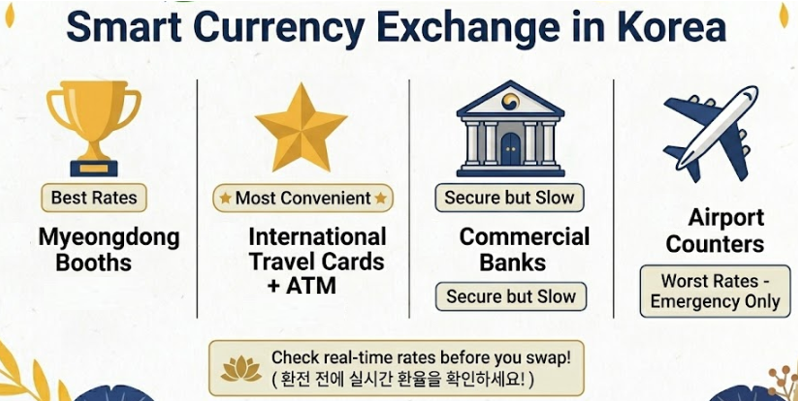
- Best rates: Private exchange booths in Myeongdong, Seoul
- Most convenient: Wise card + Korean ATM
- Avoid: Airport exchange counters — worst rates
- Best ATMs: 7-Eleven, GS25, Post Office ATMs
This korea currency exchange guide covers every option available to foreign visitors — where to get the best rates, which ATMs accept foreign cards, and how much cash you actually need. The difference between the best and worst exchange options can be significant on larger amounts. Here’s exactly where to go and what to avoid.
Korea Currency Exchange: All Options Compared
| Method | Rate Quality | Convenience | Best For |
|---|---|---|---|
| Myeongdong Exchange Booths | ⭐⭐⭐ Best | Seoul only | Large exchanges, best value |
| Wise/Revolut + ATM | ⭐⭐⭐ Near-best | Anywhere | Ongoing travel, convenience |
| Korean Bank | ⭐⭐ Good | Low (paperwork) | Smaller cities, no booths nearby |
| Airport Counter | ⭐ Poor | High | Small emergency amount only |
| Regular Bank Card + ATM | ⭐ Poor | High | Backup only — fees add up |
Option 1 — Myeongdong Private Exchange Booths (Best Rates)
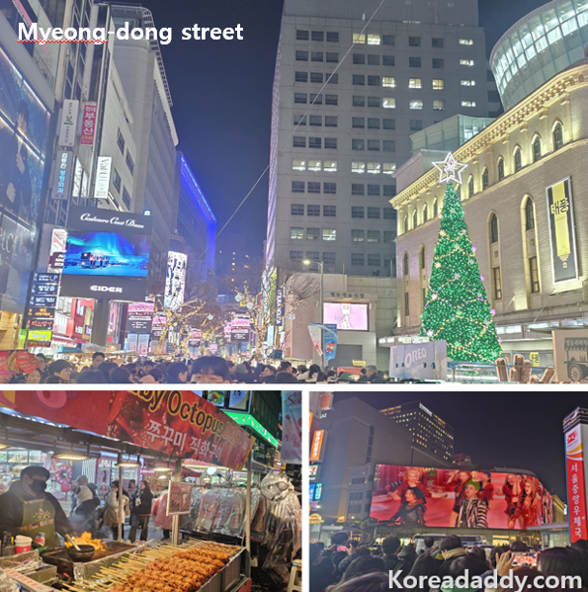
The private currency exchange booths concentrated in Myeongdong consistently offer the best rates in this korea currency exchange guide. These are licensed, legitimate operations — not back-alley deals. Competition between dozens of booths in a small area keeps rates highly competitive.
How it works: walk in, show your foreign currency, they show you the current rate on a display, you decide. No commission at most booths. The rate you see is the rate you get.
Major currencies accepted: USD, EUR, JPY, GBP, CNY, AUD, and most other major currencies. USD and JPY typically get the best rates due to high transaction volume.
Where exactly: The booths near Myeongdong subway station Exit 6 are consistently competitive. Compare two or three before committing — rates vary booth to booth and a few minutes of comparison is worth it on larger amounts.
Opening hours: Most booths open around 9 AM and close by 8–9 PM. Some stay open later on weekends. Not available 24 hours — plan accordingly.
Option 2 — Wise Card + ATM (Most Convenient)
A Wise card (formerly TransferWise) offers near-interbank exchange rates with low, transparent fees. Load your home currency, use the card at Korean ATMs, and you receive won at close to the real exchange rate with a small percentage fee — significantly better than most bank cards.
Revolut works similarly and is popular with European travelers. Both are worth setting up before you arrive if you travel internationally with any regularity.
Best ATMs for Foreign Cards in Korea
| ATM | Foreign Card Acceptance | Hours | Notes |
|---|---|---|---|
| 7-Eleven ATM | ✅ Excellent | 24 hours | Most reliable, widely available |
| GS25 ATM | ✅ Excellent | 24 hours | Reliable, found everywhere |
| Post Office ATM (우체국) | ✅ Excellent | Bank hours | Often overlooked, great acceptance |
| Woori Bank ATM | ✅ Good | 24 hours | Near tourist areas |
| KEB Hana Bank ATM | ✅ Good | 24 hours | Widely available |
| Small local savings bank | ❌ Inconsistent | Varies | Avoid — foreign card issues |
If a machine declines your card, try a different ATM before assuming the problem is with your card. Convenience store ATMs (7-Eleven, GS25) are the most reliable option for foreign cards anywhere in Korea.
Option 3 — Incheon Airport Exchange
Convenient but expensive. Airport exchange counters typically offer rates 3–5% worse than Myeongdong. On a $500 exchange, that’s $15–$25 lost compared to city rates.
When it makes sense: Exchange a small amount at the airport — ₩50,000–₩100,000 — for immediate transport and first-day needs. Exchange the rest at Myeongdong once you’re in the city.
Both Terminal 1 and Terminal 2 have exchange counters in the arrival hall, open around the clock. Rates are similar across all airport counters — shopping around at the airport doesn’t help much.
Option 4 — Korean Banks
Banks offer reasonable rates but require more time. Currency exchange at a bank typically requires a passport and involves paperwork — not complicated, just slower than a Myeongdong booth. Some smaller branches only exchange USD and JPY. Not recommended for tourists when Myeongdong is an option, but fine in smaller cities where private exchange booths don’t exist.
Reading the Exchange Rate Board
At Myeongdong booths, the rate board shows buy and sell rates for each currency. The rate you want is labeled “현찰 사실때” (buying rate from you) — this is what you receive when exchanging foreign currency for Korean won. The higher this number, the better the deal for you.
Check the real rate at xe.com or Google before you go. As a rough baseline: 1 USD = approximately ₩1,300–₩1,400 (fluctuates). Having a sense of the real rate helps you evaluate whether an exchange offer is fair.
ATM Fees — What You’re Actually Paying
When using a foreign card at a Korean ATM, you typically pay two fees: your home bank’s foreign transaction fee (usually 1–3%) and the ATM operator fee (often ₩2,000–₩5,000 per withdrawal). On a ₩200,000 withdrawal, total fees might be ₩5,000–₩10,000.
To minimize this: withdraw larger amounts less frequently rather than small amounts repeatedly. With a Wise or Revolut card, ATM fees are significantly reduced or eliminated depending on your plan.
How Much Cash to Actually Carry
Korea is largely cashless — credit and debit cards are accepted at most restaurants, shops, convenience stores, and attractions in cities. The situations where cash is genuinely needed:
- Traditional markets — Namdaemun, Gwangjang, Dongdaemun
- Street food stalls and pojangmacha tents
- Some smaller local restaurants outside tourist areas
- Temple entry fees at some smaller temples
- Coin lockers at subway stations
A practical amount: ₩50,000–₩100,000 for daily spending, with more available via ATM as needed. Carrying ₩500,000 in cash is unnecessary and adds risk — use an ATM when you need more.
Using Your Regular Bank Card
Most international Visa and Mastercard debit and credit cards work at Korean ATMs and payment terminals. American Express has more limited acceptance. Notify your bank before traveling to avoid fraud blocks on overseas transactions — a declined card at a Korean ATM at 11 PM is an easily preventable problem.
Daddy’s Final Note
The korea currency exchange guide strategy is simple: get ₩50,000–₩100,000 at the airport for the first few hours. Head to Myeongdong on day one and exchange your main budget there. If you have a Wise card, skip Myeongdong entirely and use ATMs as needed — the rates are comparable and the convenience is better. What doesn’t work: exchanging everything at the airport, or using your regular bank card at ATMs without checking the fee structure first.