Quick Answer
- From Seoul: KTX to Singyeongju Station — 2 hours, from ₩42,600 one way
- Minimum time needed: 1 full day (day trip possible, overnight recommended)
- Must-see: Bulguksa Temple, Seokguram Grotto, Tumuli Park, Cheomseongdae
- Getting around: Rental bicycle or taxi — public buses are slow
- Best season: Spring (cherry blossoms) and Autumn (foliage)
Gyeongju is one of the few cities in Korea where history is not something you visit in a museum — it is literally under your feet. The capital of the Silla Kingdom for nearly 1,000 years, Gyeongju is packed with royal tombs, Buddhist temples, and ancient astronomical observatories sitting alongside ordinary streets and convenience stores. UNESCO has designated the entire city a World Heritage Site. If you are spending more than a week in Korea and skipping Gyeongju, you are missing something genuinely irreplaceable.
Getting to Gyeongju from Seoul
KTX (Recommended)
The fastest and most comfortable option. Take the KTX from Seoul Station or Suseo (SRT) to Singyeongju Station — approximately 2 hours. Trains run frequently throughout the day. Book in advance through the Korail website or the Korail app for the best availability. From Singyeongju Station, take a local bus or taxi into Gyeongju city center (about 20 minutes).
| Route | Travel Time | Approx. Cost | Notes |
|---|---|---|---|
| KTX (Seoul → Singyeongju) | ~2 hours | ₩42,600–₩59,800 | Fastest option, book ahead |
| SRT (Suseo → Singyeongju) | ~2 hours | ₩40,700–₩56,900 | Slightly cheaper than KTX |
| Express Bus (Seoul → Gyeongju) | ~3.5–4 hours | ₩23,400–₩28,000 | Budget option, slower |
Getting Around Gyeongju
Gyeongju’s main attractions are spread across a wide area. Public buses exist but are slow and require multiple transfers. The two practical options are:
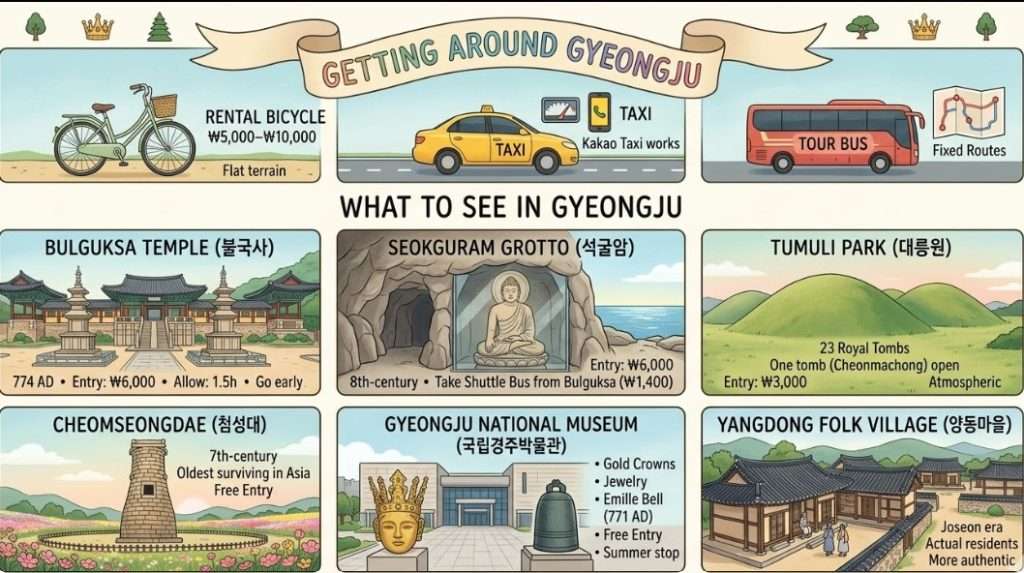
- Rental bicycle: Most popular option for independent travelers. Multiple rental shops near the city center and Bomun Lake area. Around ₩5,000–₩10,000 per day. Flat terrain makes cycling easy.
- Taxi: Affordable for short hops between sites. Use the meter — no negotiation needed. Kakao Taxi works in Gyeongju.
- Tour bus: City tour buses run fixed routes covering main attractions. Convenient if you do not want to navigate independently.
What to See in Gyeongju
Bulguksa Temple (불국사)
The most important Buddhist temple in Korea and a UNESCO World Heritage Site. Built in 774 AD, Bulguksa sits on a hillside southeast of the city and contains some of the finest examples of Silla-era stone architecture in existence — two stone pagodas (Dabotap and Seokgatap), stone staircases, and bridge structures that have survived over 1,200 years. Allow at least 1.5 hours. Entry ₩6,000 adults.
Go early — the site gets crowded by mid-morning, especially on weekends and during cherry blossom season.
Seokguram Grotto (석굴암)
Located 4km uphill from Bulguksa, Seokguram is an 8th-century artificial stone cave housing a seated granite Buddha statue considered one of the finest examples of Buddhist art in Asia. The grotto itself is enclosed behind glass to preserve it, but the setting — mountain forest, ocean views on clear days — is worth the trip alone. Entry ₩6,000 adults. Take the shuttle bus from Bulguksa (₩1,400 one way) rather than walking.
Tumuli Park (대릉원)
A park containing 23 royal tombs of the Silla Kingdom — large grass-covered burial mounds scattered across open parkland in the middle of the city. One tomb (Cheonmachong) is open to enter. The park is atmospheric at any time of day but particularly striking in early morning or at dusk. Entry ₩3,000 adults. Allow 45–60 minutes.
Cheomseongdae (첨성대)
A 7th-century astronomical observatory — the oldest surviving observatory in Asia. The stone tower is modest in size but extraordinary in age. Located a short walk from Tumuli Park. Entry is free. The surrounding fields are planted with seasonal flowers and are particularly photogenic in spring and autumn.
Gyeongju National Museum (국립경주박물관)
The best place to understand what you are seeing across Gyeongju. The museum houses artifacts recovered from Silla-era tombs — gold crowns, jewelry, pottery, and the famous Emille Bell, cast in 771 AD and one of the largest bronze bells in Asia. Free entry. Allow 1.5–2 hours. Good air conditioning makes this a practical midday stop in summer.
Yangdong Folk Village (양동마을)
A UNESCO-listed traditional Korean village 16km north of Gyeongju, largely unchanged since the Joseon era. Actual residents still live here. Less visited than the main Gyeongju sites and more authentic for it. Worth the trip if you have a second day or a rental car.
Gyeongju Itinerary — 1 Day vs 2 Days
| 1 Day (Day Trip) | 2 Days (Overnight) | |
|---|---|---|
| Morning | Bulguksa + Seokguram | Bulguksa + Seokguram |
| Afternoon | Tumuli Park + Cheomseongdae | National Museum + Tumuli Park |
| Evening | Return to Seoul | Cheomseongdae at sunset + dinner |
| Next Morning | — | Yangdong Village or Bomun Lake |
| Verdict | Possible but rushed | Recommended |
Where to Eat in Gyeongju
Ssambap (쌈밥)
Gyeongju’s most representative local meal — rice and various side dishes eaten wrapped in fresh vegetables. Available at restaurants throughout the city center. A full ssambap set runs ₩10,000–₩15,000 and includes more side dishes than you will finish.
Gyeongju Bread (경주빵)
A small red bean paste pastry that has been a Gyeongju specialty since 1939. Sold at bakeries throughout the city, particularly near Tumuli Park. Buy a box to take back — they travel well and make good gifts. Around ₩8,000–₩10,000 for a box of 10.
Hwangnam Bread (황남빵)
The original version of Gyeongju bread, made by the Hwangnam Bakery since 1939. The shop near Tumuli Park usually has a queue. Worth trying once — the red bean filling is less sweet than most Korean pastries.
Local Restaurant Street Near Tumuli Park
The streets immediately surrounding Tumuli Park have a high concentration of affordable local restaurants. Bibimbap, doenjang jjigae, and grilled fish sets run ₩8,000–₩12,000. Eat here rather than at the tourist restaurants near Bulguksa, which charge more for the same food.
Where to Stay in Gyeongju
| Option | Price Range | Best For |
|---|---|---|
| Hanok guesthouse | ₩60,000–₩120,000 | Experience traditional Korean architecture |
| Business hotel (city center) | ₩70,000–₩130,000 | Convenience, standard amenities |
| Bomun Lake resort area | ₩100,000–₩250,000+ | Scenic setting, upscale facilities |
| Guesthouse / hostel | ₩25,000–₩50,000 | Budget travelers, meeting other visitors |
Staying in the city center puts you within walking distance of Tumuli Park and Cheomseongdae. Bomun Lake area is quieter and more scenic but requires transport to reach the main sites.
Practical Information
| Item | Details |
|---|---|
| Bulguksa entry | ₩6,000 adults, ₩4,000 youth |
| Seokguram entry | ₩6,000 adults, ₩4,000 youth |
| Tumuli Park entry | ₩3,000 adults, ₩2,000 youth |
| National Museum entry | Free |
| Cheomseongdae entry | Free |
| Bicycle rental | ₩5,000–₩10,000/day |
| Singyeongju → city center taxi | ~₩15,000–₩20,000 |
| Best season | April (cherry blossoms), October (foliage) |
Daddy’s Final Note
Most visitors to Korea spend all their time in Seoul and leave without seeing what the country looked like before the 20th century. Gyeongju is the answer to that. The royal tombs sitting in the middle of an ordinary city, the 1,200-year-old temple on the hillside, the stone Buddha facing the sea — none of this feels like a theme park version of history. It is the real thing, and it is still standing.
If you have two weeks in Korea, Gyeongju deserves two nights. If you only have one week, make it a day trip from Busan rather than Seoul — Busan to Gyeongju is 40 minutes by train and makes the logistics much easier.