Quick Answer
- Daily budget: ₩50,000-₩80,000 per day is very comfortable if you know where to spend
- Biggest savings: Food and transport — both are genuinely cheap in Korea
- Biggest traps: Taxis instead of subway, tourist restaurants, convenience store premium items
- Free things: Most palaces have free entry days, all national museums are free
Korea is one of the better countries in Asia for budget travel — not because everything is cheap, but because the cheap options are genuinely good. The subway works. The street food is excellent. The convenience stores are real meals. You can travel Korea well without spending much, and this is how.
This korea budget travel guide covers exactly how to travel Korea well without spending much — from daily food costs to free attractions and where most visitors waste money.
What Korea Actually Costs
| Category | Budget Option | Cost |
|---|---|---|
| Accommodation | Hostel dorm | ₩15,000-₩25,000/night |
| Accommodation | Guesthouse private room | ₩40,000-₩70,000/night |
| Breakfast | Convenience store | ₩3,000-₩5,000 |
| Lunch | Korean set meal (백반) | ₩7,000-₩10,000 |
| Dinner | Kimbap restaurant | ₩5,000-₩8,000 |
| Transport | Subway per ride | ₩1,400-₩1,600 |
| Coffee | Local cafe Americano | ₩1,500-₩2,500 |
| Snack | Street food item | ₩1,000-₩3,000 |
A realistic daily budget eating Korean food, using the subway, and staying in a guesthouse: ₩60,000-₩80,000 per day. This is not roughing it — this is eating well and moving comfortably around one of Asia’s best cities.

Accommodation
Hostels in Hongdae and Insadong are the best value in Seoul — dorm beds from ₩15,000, private rooms from ₩40,000. Quality is generally good. Read reviews from the past three months specifically — hostel quality can change quickly.
Guesthouses offer private rooms at lower prices than hotels. Many include a simple breakfast. Hongdae, Mapo, and Insadong have the best concentration of good-value guesthouses.
Jjimjilbang overnight is the extreme budget option — ₩10,000-₩15,000 entry plus a small overnight fee gets you a warm heated floor to sleep on. Legitimate, safe, and used regularly by Korean travelers. Not for everyone but it works.
Avoid: Hotels in Myeongdong charge a premium for the location. The subway makes proximity to tourist sites less important than it looks on the map.
Food
Food is where Korea budget travel really delivers. Eating well and cheaply is not a compromise here — it is the natural way to eat.
Baekban restaurants (백반집): Korean home-style set meal restaurants. Fixed price of ₩7,000-₩10,000 gets you rice, soup, and 4-6 side dishes. Full meal. These are where Korean office workers eat lunch and they are excellent. Look for small restaurants with handwritten menus and Korean customers.
Kimbap restaurants (김밥천국 style): Fast, cheap, large menu. Kimbap from ₩3,000, bibimbap ₩6,000, ramen ₩4,000. These are everywhere and consistently reliable. Not exciting but genuinely good value.
Street food: Tteokbokki (spicy rice cakes) ₩3,000-₩4,000, hotteok (sweet pancakes) ₩1,000-₩2,000, odeng (fish cake skewers) ₩500-₩1,000 each. Gwangjang Market and Namdaemun Market have the best concentration in Seoul.
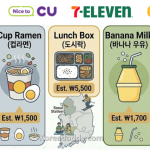
Convenience stores: Samgak kimbap ₩1,200-₩1,500, steamed buns ₩1,000-₩1,500, cup ramen ₩1,000-₩1,500. GS25 and CU have better food quality than 7-Eleven. A full convenience store meal costs ₩3,000-₩5,000.
Lunch over dinner: Many Korean restaurants offer lunch sets for 20-40% less than the same food at dinner. Eat your main meal at lunch and keep dinner simple.
Avoid: Restaurants with menus in multiple languages right at tourist site entrances. Coffee at hotel lobbies. Branded international chains — you are in Korea, not at a Starbucks.
Transport
Seoul’s subway is one of the cheapest and best in the world. A single ride costs ₩1,400-₩1,600 depending on distance. With a T-money card you get transfer discounts between bus and subway — tap out and back in within 30 minutes and the second ride is heavily discounted.
T-money card: Buy at any convenience store for ₩2,500, load with cash. Use on subway, buses, and some taxis. Essential for budget travel — cash fares on buses are higher and slower.
Between cities: Express buses (고속버스) are significantly cheaper than KTX for intercity travel. Seoul to Busan by express bus costs around ₩23,000 versus ₩59,800 by KTX. Takes about 4.5 hours versus 2.5 hours. Worth it if time is not the priority.
Avoid: Taxis for regular sightseeing — they add up quickly. Taxis are fine for late nights or when you have heavy luggage, not for daily movement around the city.
Free and Cheap Attractions
Completely free:
- National Museum of Korea (Yongsan) — one of the best museums in Asia, free entry
- National Folk Museum of Korea — inside Gyeongbokgung, free with palace entry or independently free on some days
- Bukchon Hanok Village — free to walk through
- Cheonggyecheon stream — free, excellent evening walk through central Seoul
- Han River parks — free, bring your own food and join the Koreans
- Namsan mountain walk — free, good views, skip the cable car
- Insadong and Ikseon-dong — free to explore, just watch your cafe spending
Cheap paid attractions:
- Gyeongbokgung Palace — ₩3,000 entry, free on last Wednesday of each month
- Changdeokgung Palace — ₩3,000, UNESCO World Heritage site
- N Seoul Tower observation deck — ₩16,000, views of the whole city. Or hike Namsan for free and see the tower from outside.
- Jjimjilbang — ₩10,000-₩15,000 for hours of entertainment and a genuine Korean experience
Practical Money Tips
Exchange money at Myeongdong private booths, not at the airport. The difference on a 00 exchange is 5-5. Not huge but worth knowing.
Withdraw larger amounts less often. ATM fees apply per withdrawal. One ₩200,000 withdrawal is cheaper than four ₩50,000 withdrawals.
Buy a data SIM at the airport rather than paying international roaming fees. A 10-day SIM costs ₩15,000-₩25,000. Roaming fees from home carriers can easily exceed this in one day.
Avoid buying water in tourist areas. Carry a reusable bottle. Korean tap water is safe to drink and free water is available at most museums and tourist sites.
Where Budget Travelers Overspend
Coffee: Branded cafes charge ₩5,000-₩7,000 for a latte. Local Korean cafes charge ₩1,500-₩2,500 for Americano. The local version is often better. Korea has an extraordinary cafe culture — explore it rather than defaulting to international chains.
Souvenirs at tourist sites: Overpriced. The same items are available at Namdaemun Market or Dongdaemun Market for a fraction of the cost. Buy souvenirs at markets, not at palace gift shops.
Tours: Many popular experiences — palace visits, neighborhood walks, market exploration — require no tour guide. Naver Map and a bit of research replace a ₩50,000-₩100,000 guided tour in most cases. Save tours for experiences where local knowledge genuinely adds value, like a specific cooking class or a DMZ visit.
Sample Budget Day in Seoul
| Item | Cost |
|---|---|
| Breakfast — convenience store kimbap and coffee | ₩4,000 |
| Subway — morning sightseeing | ₩1,600 |
| Gyeongbokgung Palace entry | ₩3,000 |
| Lunch — baekban set meal near Insadong | ₩9,000 |
| Afternoon — Bukchon walk, Cheonggyecheon | Free |
| Street food snack — tteokbokki | ₩3,000 |
| Subway home | ₩1,600 |
| Dinner — kimbap restaurant | ₩7,000 |
| Total | ₩29,200 |
That is a full day of genuine Seoul experiences — a major palace, a historic neighborhood, street food, two proper meals — for under ₩30,000. Add a guesthouse at ₩50,000 and your total day costs ₩80,000. This is what budget travel in Korea actually looks like.
Daddy Final Note
The trap most budget travelers fall into in Korea is spending money where Koreans don’t — tourist restaurants, branded cafes, taxis for short trips. Spend where Koreans spend and you eat better, travel more comfortably, and spend significantly less. Korea’s best food is not in the expensive restaurants. Its best transport is not taxis. The country is set up well for people who pay attention.