Quick Answer
- What it is: Hanbang (한방) — Korean traditional medicine practiced at a Haniwon (한의원) clinic
- Main treatments: Acupuncture (침), Cupping/Buhwang (부항), Moxibustion (뜸), Herbal medicine (한약)
- Cost for foreigners: ₩30,000–₩70,000 per session without Korean health insurance
- English available: Yes — look for clinics marked “International” or in tourist areas like Myeongdong and Gangnam
- Walk-ins: Accepted at most clinics — no appointment needed for a first visit
If you have been walking the streets of Seoul, you have probably noticed the green cross signs everywhere — many of them say 한의원 (Haniwon). These are not regular pharmacies or hospitals. They are Korean traditional medicine clinics, and they have been treating Koreans for over 2,000 years. As a local dad who grew up going to these clinics with my grandmother, I can tell you: this is one of the most genuinely Korean wellness experiences you can have here, and far less intimidating than it looks from the outside.
This hanbang korean traditional medicine guide covers everything you need to walk into a Haniwon clinic confidently — treatments explained, costs, and step-by-step what happens.
What Is Hanbang (한방)?
Hanbang is the Korean system of traditional medicine, developed over centuries and still widely practiced today alongside Western medicine. Unlike Western medicine, which typically treats a specific symptom or organ in isolation, Hanbang looks at the body as a whole. The core philosophy is balance — specifically the balance of Qi (기, energy flow) and the interaction of the Five Elements within the body.
When you visit a Haniwon, the doctor does not just look at your sore shoulder. They check your pulse on both wrists, examine your tongue, ask about your digestion, sleep, and stress levels — and use all of this to identify the root imbalance causing the problem. It is a different way of thinking about health, and for many conditions — chronic fatigue, muscle pain, digestive issues, stress — Koreans find it works where Western medicine has not helped.
Hanbang is not alternative medicine here. It is mainstream. Korean health insurance covers many Hanbang treatments, and most Koreans use both systems depending on what the condition calls for.
The Main Treatments at a Haniwon
Acupuncture (Chim, 침)
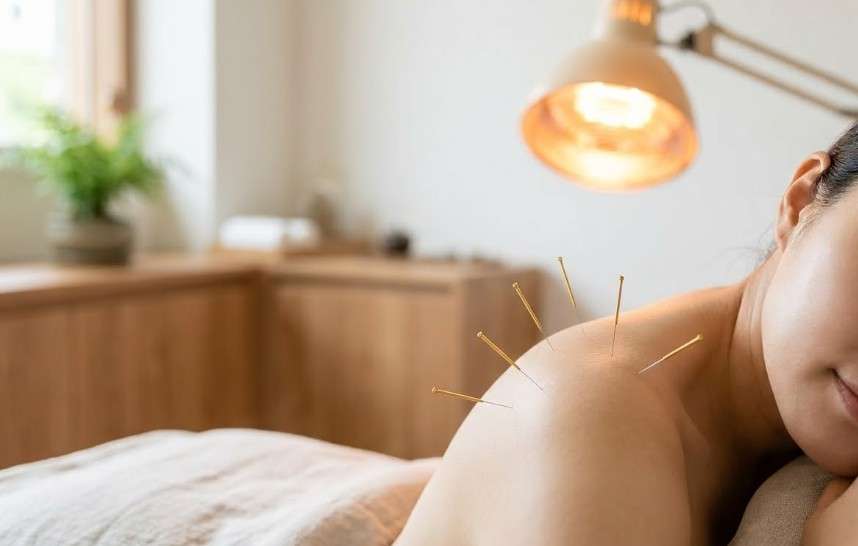
Thin needles — much thinner than the needles used for injections — are placed at specific points along the body’s energy meridians to restore the flow of Qi. Most people expect it to hurt. Most people are surprised when it does not. You may feel a mild pressure or a brief “zing” when a needle hits the right point, but the session itself is usually deeply relaxing. You lie still for 15–20 minutes under a heat lamp while the needles work. Many people fall asleep.
Acupuncture is effective for muscle pain, headaches, chronic fatigue, anxiety, and digestive issues, among many other conditions. It is the most common treatment at a Haniwon and almost every visit includes it.
Cupping — Buhwang (부항)
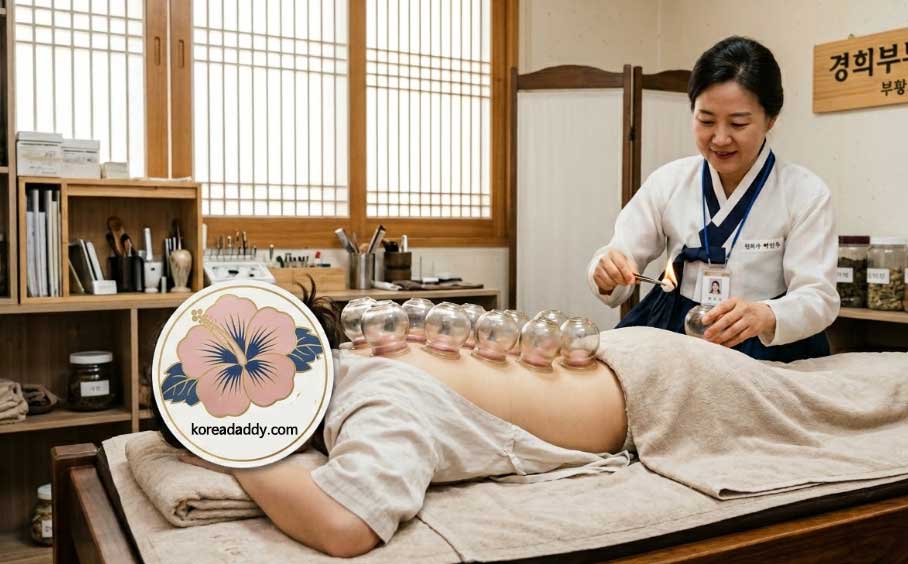
Buhwang is one of the most distinctive Hanbang treatments and one of the most effective for muscle tension and pain. Glass or plastic cups are applied to the skin — usually the back — and a vacuum is created either by heat or a pump. The suction draws blood to the surface, releases muscle tightness, and is believed to help remove toxins and improve circulation.
The sensation is unusual but not painful — more like a deep, pulling pressure. Many people find it intensely satisfying, especially on a tight upper back. The treatment leaves round purple or red marks on the skin that look alarming but are not bruises — they are pooled blood close to the surface and fade within 3–7 days. In Korea, these marks are genuinely worn as a badge of honor. Nobody in a Korean bathhouse will look twice.
| Buhwang Type | Method | Best For |
|---|---|---|
| Dry cupping (건식 부항) | Cups applied with suction only | Muscle tension, general circulation |
| Wet cupping (습식 부항) | Small incision + suction to draw blood | Deeper detox, chronic pain — ask the doctor |
| Sliding cupping (주행 부항) | Cups moved across oiled skin | Broad back tension, relaxation |
Moxibustion (Tteum, 뜸)
Moxibustion involves burning dried mugwort (Ssuk, 쑥) near or on the skin to apply gentle, penetrating heat to specific acupuncture points. The heat from moxa goes deeper than a heat pad — it warms not just the skin but the underlying tissue and meridian points. It is particularly good for cold hands and feet, digestive weakness, and fatigue caused by what Hanbang calls a “cold constitution.” The smell of burning mugwort — slightly herbal, slightly smoky — is very distinctly Korean. You will recognize it instantly if you have ever walked past a Haniwon with the door open.
Herbal Medicine (Hanyak, 한약)
Depending on your consultation, the doctor may prescribe a course of herbal medicine — either as dried herbs to brew at home, or more commonly these days as pre-packaged liquid pouches (탕약) you drink once or twice daily. Korean herbal formulas are complex — often 10–20 ingredients precisely balanced for your specific condition and constitution. They are not sold off the shelf. The doctor formulates them for you individually.
The taste ranges from mildly bitter to very bitter depending on the formula. There is a Korean saying: 좋은 약은 입에 쓰다 — “Good medicine is bitter to the mouth.” Herbal medicine is significantly more expensive than a single treatment session and is not always necessary for a one-off visit, but for chronic conditions it is the cornerstone of Hanbang treatment.
Step-by-Step: Your First Haniwon Visit
Step 1 — Finding the right clinic. In tourist areas like Myeongdong, Insadong, Hongdae, and Gangnam, many clinics have English-speaking staff or English intake forms. Look for signs saying “International Clinic” or “K-Medicine Service Center.” In non-tourist neighborhoods, Google Translate on your phone handles the basics fine.
Step 2 — Walk in and register. Most Haniwon accept walk-ins. Walk up to the front desk and say 안녕하세요 (annyeong-haseyo). In tourist-area clinics, they will switch to English. You will fill in a basic intake form — name, age, and your main complaint. Keep it simple: “back pain,” “fatigue,” “shoulder tension.”
Step 3 — The consultation. The doctor will check your pulse — not just counting beats, but feeling the quality and depth at several positions on both wrists. They will ask you to show your tongue. They may ask about digestion, sleep quality, stress, and whether you tend to feel hot or cold. Answer honestly. This is not small talk — it is the diagnostic process.
Step 4 — Treatment. You will be taken to a treatment room and asked to lie down on a heated table — ondol-style warmth from below. The doctor or assistant will apply whichever treatments were decided: usually acupuncture plus cupping or moxibustion. You rest for 15–20 minutes. The room is quiet. Many people fall asleep.
Step 5 — Post-treatment advice. The doctor will give brief aftercare instructions. Standard advice: avoid cold water and cold drinks for a few hours, wait 2–3 hours before showering, rest if possible. If herbal medicine was prescribed, they will explain the dosage.
Step 6 — Payment. Pay at the front desk. Without Korean national health insurance, foreigners pay the full rate: typically ₩30,000–₩50,000 for acupuncture, ₩10,000–₩20,000 additional for cupping. Some clinics bundle treatments at a fixed foreigner rate.
Cost Breakdown for Foreigners
| Treatment | Korean (with insurance) | Foreigner (no insurance) |
|---|---|---|
| Acupuncture (침) | ₩5,000–₩15,000 | ₩30,000–₩50,000 |
| Cupping / Buhwang (부항) | ₩3,000–₩8,000 | ₩10,000–₩20,000 |
| Moxibustion (뜸) | ₩3,000–₩8,000 | ₩10,000–₩20,000 |
| Combined session | ₩10,000–₩25,000 | ₩40,000–₩70,000 |
| Herbal medicine (1 week) | ₩30,000–₩80,000 | ₩80,000–₩200,000+ |
The gap between Korean and foreigner prices reflects health insurance subsidies, not clinic greed. Foreigners pay the unsubsidized rate. For a single wellness experience during a trip, ₩50,000–₩70,000 is reasonable. Compare it to a massage at a tourist spa charging ₩80,000–₩120,000 for less therapeutic benefit.
What Conditions Is Hanbang Good For?
Koreans commonly visit a Haniwon for: chronic back and neck pain, shoulder tension from desk work, fatigue and low energy, digestive problems, headaches and migraines, insomnia, stress and anxiety, recovery from sports or physical strain, and general wellness maintenance. For travelers, the most common and practical reasons to visit are back pain from carrying a heavy pack, muscle fatigue from extensive walking, and general stress relief mid-trip.
Practical Tips Before You Go
Wear loose clothing. You will need to roll up sleeves and trouser legs, or change into clinic-provided loose pants. Avoid tight jeans or a dress.
Eat lightly beforehand. Do not visit on a full stomach or completely empty — a light meal 1–2 hours before is ideal.
Mention everything relevant. If you are pregnant, have a pacemaker, take blood thinners, or have any skin conditions, tell the doctor before treatment. These affect which treatments are appropriate.
The cupping marks are normal. If you are going to a jjimjilbang or beach within the next week, be aware that buhwang marks last 3–7 days. They are not painful, just visible.
Do not shower immediately after. Wait at least 2 hours post-treatment. The skin pores are open after cupping especially.
Daddy’s Final Note
My grandmother took me to a Haniwon every time I had low energy as a child. I complained every time. The herbal medicine was bitter, the needles looked frightening, and I did not understand why I could not just take a pill. Now, as an adult who has tried both systems for years, I understand what she knew: Hanbang treats the condition, not just the symptom. If you have a sore back from days of walking Seoul, a good Haniwon session will do more for you than a painkiller. Skip one tourist attraction, find a green cross sign, walk in, and let a doctor who has been practicing this for decades take a look at you. Your body will thank you for it — probably more than any temple or palace on your itinerary.