Every Korea travel guide tells you to try Korean BBQ and visit Gyeongbokgung Palace. Fine advice. Here is the stuff they don’t tell you — things I’ve watched foreign visitors learn the hard way, and things that will make your trip significantly better.
These korea travel tips cover what most guides skip — the things foreign visitors learn the hard way, and the small details that make a real difference on the ground.
Daddy’s Note: This is the list I give friends who visit Korea. No obvious tips. No padding. Just the things that actually matter.
Getting Around
Google Maps will get you lost. Korean mapping data is legally restricted from Google. Use Naver Map instead — it works in English and it’s accurate. This single switch will prevent more frustration than anything else on this list.
The subway exit number matters as much as the station. Korean subway stations can have 10+ exits spread over a large area. Getting off at the right station but the wrong exit means a 10-minute walk in the wrong direction. Always check the exit number in Naver Map before you get off.
Taxis are not scary. Korean taxis are metered, regulated, and honest. Use Kakao Taxi for transparent pricing and card payment. In a group of 3-4 people, a taxi is often cheaper than the subway once you factor in convenience.
The T-money card works everywhere. Subway, bus, some taxis, convenience stores, even some vending machines. Load it at any convenience store. Transfer discounts between bus and subway apply automatically when you tap out and back in within 30 minutes.
Naver Map walking directions are literal. Korean maps sometimes route you through building lobbies and underground shopping areas. If the route looks odd, zoom in — it probably wants you to go through a building or underground passage. This is normal and usually faster than going around.

Money
Cash is more important than you think. Korea is largely cashless but traditional markets, small local restaurants, and street food stalls are often cash only. Carry 50,000-100,000 won at all times.
The best ATM is at a 7-Eleven or GS25. Convenience store ATMs reliably accept foreign cards. Bank ATMs are often foreign-card-unfriendly. When in doubt, find a convenience store.
Don’t exchange money at the airport. Rates are poor. Exchange in Myeongdong for the best rates in Seoul, or use a Wise card for ATM withdrawals throughout your trip.
Koreans split bills individually, not equally. At group meals, each person often pays for exactly what they ordered rather than splitting the total evenly. Some restaurants even have individual ordering systems for this reason. Don’t assume a shared bill split equally is the default.
Food
The side dishes (banchan) are free and refillable. The small dishes arriving before your main meal are complimentary. You can ask for more of anything. Many tourists eat them cautiously not realizing refills are standard — just wave to the server and point.
Spicy in Korea means something different. When a Korean says something is a little spicy (조금 매워요), calibrate accordingly. Korean spice tolerance runs high. If you have a low tolerance, ask clearly and watch the reaction, not just the words.
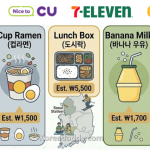
The convenience store is not a backup plan. Korean convenience store food is genuinely good. Samgak kimbap, steamed buns, and cup ramen are real meals, not emergency rations. GS25 and CU have better food options than 7-Eleven.
Lunch sets are significantly cheaper than dinner. Many Korean restaurants offer a fixed lunch set (점심 특선) for 30-40% less than the same food at dinner. If budget matters, eat your main meal at lunch.
You pay at the counter on the way out, not at the table. Most Korean restaurants work this way. When you’re ready to leave, stand up and go to the register. Don’t wait for a bill to come to your table.
Culture and Etiquette
Koreans don’t say excuse me when passing in a crowd. Not rudeness — just different. Don’t take it personally when someone moves past you without verbal acknowledgment in a busy market or subway car.
Pointing with one finger is considered rude. Use two fingers or an open hand when directing someone’s attention to something.
Pour for others before pouring for yourself. At restaurants and bars, pour drinks for the people around you first. Let others pour for you. Pouring your own drink without offering others first is considered self-centered.
Tipping is not part of Korean culture. Do not tip at restaurants, taxis, hotels, or anywhere else. It causes confusion. Service is included in the price — that is the system.
Older people board buses and subways first. If an older person is waiting at a bus stop or subway platform, let them board before you. This is observed consistently in Korea and noticed when foreigners don’t follow it.
The priority seats on the subway are actually used. The seats marked for elderly, pregnant, and disabled passengers are left empty by most Koreans even when the train is crowded — they are genuinely reserved. Do not sit in them.
Technology
Get a Korean SIM card at the airport. Available immediately at booths in the arrival hall. A 10-day data SIM costs around 15,000-25,000 won. Without data, navigation and translation become significantly harder. Do this before leaving the airport.
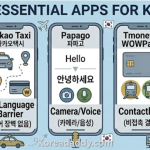
Download these apps before arrival: Naver Map (navigation), Kakao Taxi (taxis), Papago (translation with camera function), and Kakao Bus (real-time bus tracking). All free, all essential.
Papago camera function is genuinely useful. Point your phone camera at any Korean text — menus, signs, instructions — and it translates in real time. More accurate than Google Translate for Korean. Use it constantly.
Weather
Korean summers are genuinely brutal. June-August humidity in Seoul is extreme. Essential items: a small portable fan, cold barley tea, and realistic expectations about afternoon walking. Schedule outdoor activities for early morning or evening during summer.
Korean winters are colder than most people expect. Seoul in January averages -5 to -3 degrees Celsius with wind. A proper winter coat, not just a light jacket, is necessary. The good news: indoor spaces are heated aggressively.
Yellow dust (황사) season is March-May. Fine dust from Chinese deserts blows into Korea during spring. On bad days, outdoor activity is uncomfortable and masks are advisable. Check the air quality index on Naver before planning outdoor activities.
Practical Stuff
The pharmacy is your first stop for minor illness. Korean pharmacists are knowledgeable and experienced with foreign visitors. Faster and cheaper than finding a clinic for a cold or stomach issue. Show symptoms on Papago if language is a barrier.
Public restrooms in Korea are generally excellent. Subway stations, parks, and tourist sites all have clean, well-maintained restrooms. Toilet paper is not always provided inside the stall — it is sometimes placed at the entrance to the restroom. Take some before entering the stall.
The 1330 Tourism Hotline is genuinely useful. English-speaking staff, 24 hours, can help with lost items, transport questions, medical emergencies, and general guidance. Save it in your phone before you need it.
Korean customer service moves fast. Servers in restaurants respond quickly and expect you to be ready to order. Have a rough idea of what you want before calling them over. Taking five minutes to decide after summoning the server is considered inconsiderate.
The One Thing Most Visitors Regret
Spending too much time in the main tourist areas and not enough time in the neighborhoods between them. Ikseon-dong, Mangwon Market, Seongsu-dong, Yeonnam-dong, Euljiro — these are where Seoul actually lives. Accessible by subway, not crowded with tour groups, and the food and coffee are often better and cheaper than the tourist hotspots.
Korea rewards curiosity. The best experiences here almost always happen one street past the obvious destination.