Quick Answer
- Overall difficulty: One of the easiest solo travel destinations in Asia for foreigners
- Biggest advantage: Public transport is excellent, safe, and cheap everywhere
- Biggest challenge: Language barrier at non-tourist restaurants and rural areas
- Safety: Exceptionally safe — violent crime against tourists is rare to the point of being a non-issue
- Solo-friendly cities: Seoul, Busan, Gyeongju, Jeonju — all work well alone
Korea does not get enough credit as a solo travel destination. Most coverage focuses on group tours, couples, or K-drama pilgrimage trips. But for a single traveler who wants to move at their own pace, eat what they want, and actually understand a place — Korea is genuinely one of the best countries in Asia to do it in. This is the honest version of what to expect.
What Is Surprisingly Easy
Getting Around
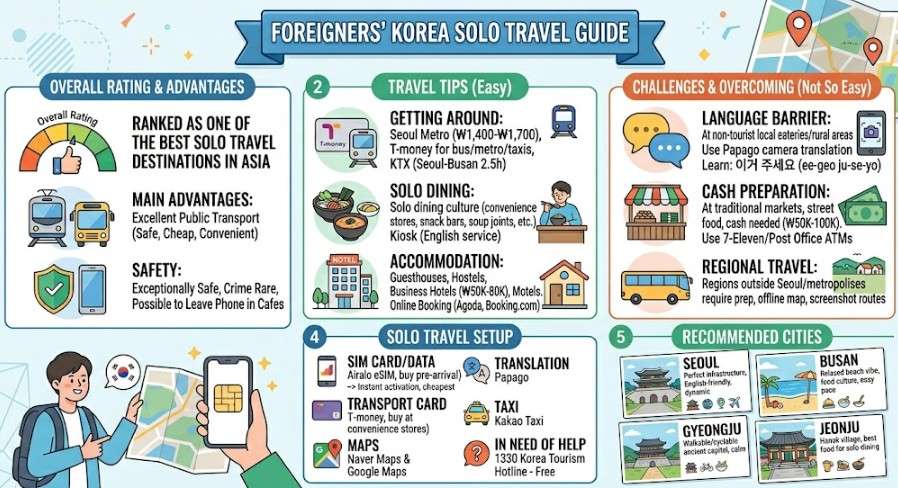
The public transport system in Korea is one of the best in the world for a solo traveler. Seoul Metro covers nearly every tourist area, runs until after midnight, and costs ₩1,400-₩1,700 per ride. The T-money card works on buses, metro, and even some taxis. KTX trains connect Seoul to Busan in 2.5 hours, Gyeongju in 2 hours, and Jeonju in under 2 hours — book online through Korail or the SRT app. You do not need to speak Korean to navigate any of this. Signage is in English on every major line.
One thing nobody mentions: the Seoul Metro skips certain stations during major events (concerts at KSPO Dome, large demonstrations near Gwanghwamun). If your train is not stopping where you expected, this is usually why. Check the metro app for real-time updates rather than assuming your app is wrong.
Staying Safe
Korea is one of the safest countries in the world for solo travelers, including solo women. Leaving your phone on a café table while you use the bathroom is normal here. Losing your wallet at a restaurant and having someone hand it in is a genuine common occurrence. Nighttime in Seoul, Busan, or any major city is not something to be anxious about. This is not a marketing statement — it reflects daily reality for the millions of people who live and travel here.
The only real safety nuance: traffic. Korean drivers, particularly in older cities and around markets, do not always yield to pedestrians at crossings. Look both ways even on one-way streets. Motorcycles and delivery scooters use pavements in some areas.
Finding Food Alone
Solo dining is completely normal in Korea. Convenience stores, kimbap restaurants, gukbap (rice soup) spots, and ramen shops are designed for it — counter seats, solo portions, no awkward table-for-one situations. Many Korean restaurants have automated ordering kiosks with English options, which removes the language barrier entirely. You will not feel out of place eating alone here the way you might in some other Asian countries where group dining is the norm.
Accommodation
Solo travelers are well catered for. Guesthouses and hostels in Seoul, Busan, and Jeonju are plentiful, affordable, and often well-located. Single rooms at business hotels run ₩50,000-₩80,000 per night in most cities. Motels are everywhere and perfectly usable — the stigma around them exists for Koreans, not foreigners. Most accommodation has English-language booking via Agoda, Booking.com, or directly through the property. Check-in is straightforward at most places even without Korean.
Using Your Phone
Get an Airalo eSIM before you fly. A 10-day Korea data plan costs around $10-12 USD and activates immediately on arrival. With data on your phone, Google Maps, Naver Maps, Papago (translation), and Kakao Taxi work everywhere. This single step removes 80% of the practical difficulty of solo travel in Korea. Do not rely on airport SIM counters — they are slower, more expensive, and have queues.
What Is Not So Easy
The Language Barrier at Local Restaurants
Tourist areas are fine — menus have pictures, staff expect foreigners, some English is available. But the best cheap Korean food exists in local neighborhoods away from tourist zones, and those restaurants often have handwritten Korean-only menus, no pictures, and staff with zero English. This is where solo travel gets genuinely harder. The solution is Papago’s camera translation function — point your phone at the menu and it renders a live translation. It is not perfect but it is enough. Learn three words: 이거 주세요 (ee-geo ju-se-yo) — “I’ll have this one.” Point at what the person next to you is eating. It works.
Booking Certain Experiences
Some traditional experiences — specific temple stays, cooking classes, rural guesthouses — require Korean-language booking or phone calls. The Korail website works in English but can be slow and occasionally glitchy for foreign credit cards. Use the 1330 Korea Travel Hotline (free from Korean SIM numbers, also available via KakaoTalk) when you hit a booking wall — they will make the call for you. This service is underused by foreign travelers and genuinely useful.
Rural and Small City Travel
Seoul and the major cities are easy. Step outside them and difficulty increases. Intercity buses often have Korean-only booking interfaces. Local buses in smaller towns have no English signage. Restaurants in rural areas are almost entirely Korean-only. This is manageable but requires more preparation — download offline maps, screenshot your route in advance, and accept that some guesswork is part of the experience. The countryside is worth the added effort.
Banking and Card Payments
Most places in Seoul accept foreign Visa and Mastercard without issue. Traditional markets, street food stalls, and small local restaurants are still frequently cash-only. Withdraw Korean won from a 7-Eleven or Post Office ATM — both reliably accept foreign cards. GS25 and CU convenience store ATMs work most of the time but occasionally reject foreign cards. Have ₩50,000-₩100,000 cash on you at all times. The Myeongdong currency exchange booths offer competitive rates and no commission — better than airport rates by a meaningful margin.
Meeting People
Koreans are not unfriendly, but they are reserved with strangers in ways that can feel like coldness to foreign solo travelers used to more open travel cultures. Striking up conversations at cafes or on transport is not typical here. If you want social connection as a solo traveler, guesthouses with common areas are the best option — the social dynamic is built in. The expat and travel communities on Meetup Korea and various Facebook groups also run regular events in Seoul that welcome visitors.
Practical Solo Travel Setup
| Item | Recommendation | Why |
|---|---|---|
| SIM / Data | Airalo eSIM (buy before arrival) | Instant activation, cheapest option |
| Transport card | T-money (buy at any convenience store) | Works on metro, bus, and some taxis |
| Maps | Naver Maps + Google Maps (download offline) | Naver is more accurate for Korea addresses |
| Translation | Papago (camera mode for menus) | Better Korean translation than Google Translate |
| Taxi | Kakao Taxi | English interface, set pickup/dropoff in app |
| Help hotline | 1330 Korea Travel Hotline | Free, English-speaking, genuinely useful |
| Cash | ₩50,000-₩100,000 minimum at all times | Markets and local restaurants still cash-only |
Best Cities for First-Time Solo Travel in Korea
Seoul: The obvious starting point. Everything works in English, transport is near-perfect, and there is enough to fill two weeks without repeating yourself. Overwhelming for some people on day one — give it 48 hours and it becomes intuitive.
Busan: Smaller, more relaxed, easier to navigate on foot between main areas (Haeundae, Gwangalli, Nampo-dong). Better for solo travelers who want some breathing room from Seoul’s pace. The food culture is excellent and slightly different from Seoul.
Gyeongju: The easiest slow-travel option in Korea. Ancient capital, walkable and cyclable, genuinely calm. Solo travelers who want history without crowds do well here. Fewer English menus outside the main tourist strip — lean on Papago.
Jeonju: Best food city in Korea for solo dining. The hanok village area is compact, guesthouses are abundant, and the local food scene (bibimbap, makgeolli bars, street food) is designed around individual servings and informal eating. Good two-night stop.
Solo Travel as a Woman in Korea
Korea consistently ranks among the safest countries for solo female travelers in Asia. Late-night solo walking in Seoul or Busan is not something most Korean women think twice about — and most female solo travelers report the same. The main practical adjustment: some motels and love hotels are uncomfortable for solo female check-in due to the nature of the establishments, though this is rarely a safety issue — just an atmosphere issue. Guesthouses and business hotels are entirely straightforward. The women-only carriages on Seoul Metro (pink signage, front and rear cars) exist and are enforced during peak hours if you prefer them.
Daddy’s Final Note
The foreigners I see struggling in Korea are usually the ones who did no preparation and expected everything to work the same way it does at home. The ones who thrive are the ones who downloaded two apps, got a T-money card from the convenience store, and accepted that pointing at a menu is not embarrassing — it is just how it works. Korea rewards a small amount of effort with a disproportionately good experience. Solo travel here is genuinely easier than it looks from the outside. The language barrier sounds bigger than it is. The safety concern does not exist. Go alone. You will be fine.