What it is: Slow-braised pig’s trotters in soy sauce, ginger, and garlic
Best with: Naengmyeon (cold noodles), soju, and shrimp paste (새우젓)
Best area: Jangchung-dong — Seoul’s original jokbal street
Price: ₩30,000–₩45,000 for a medium portion (serves 2–3)
If you have walked past a Korean restaurant at night and seen a table full of people pulling apart glossy, dark-braised meat with chopsticks and wrapping it in lettuce — that was probably jokbal (족발). It is one of Korea’s most beloved late-night foods, and once you try it properly, you will understand why.
What Is Jokbal?
Jokbal is pig’s trotters — the feet and lower leg — slow-braised for several hours in a broth of soy sauce, garlic, ginger, rice wine, and spices until the meat is fall-off-the-bone tender. The skin takes on a deep mahogany color and a glossy, slightly sticky texture. The flavor is rich and savory with a faint sweetness from the soy and spices.
It is served sliced, already off the bone, on a large platter — dark outer skin on top, pale tender meat underneath. You eat it wrapped in lettuce or perilla leaves with a dab of shrimp paste (새우젓, saeujeot) on the side.
The Collagen Factor — Why Koreans Love It
Koreans have eaten jokbal for centuries partly for practical reasons — it is cheap, filling, and uses a part of the animal that would otherwise go to waste. But there is another reason it has stayed popular: collagen.
Pig’s trotters are exceptionally high in collagen — the protein that gives skin elasticity and joints flexibility. The slow braising process breaks down the collagen into gelatin, which is why jokbal has that distinctive rich, slightly sticky texture and why the skin is so soft it practically melts. Korean women in particular have long associated jokbal with skin health — it is not uncommon to hear someone ordering it and half-joking that it is their beauty treatment.
Whether or not the collagen benefit is as dramatic as claimed, the texture it creates is genuinely unlike anything else. The combination of the soft, yielding skin and the tender meat underneath is what makes jokbal worth trying even if you are skeptical about the pig’s trotter concept.
Hot Jokbal vs Cold Jokbal
Hot jokbal (온족발): The classic version. Served warm, soft skin, tender meat. Best in cold weather and with soju.
Cold jokbal (냉족발): Chilled after braising, sliced thin. Firmer texture, slightly chewy skin. Served with a spicy sauce. More popular in summer. Some restaurants specialize in this version — Ribukjip in Gangnam is one of the most well-known.
How to Eat Jokbal
Take a lettuce or perilla leaf in your palm
Place a piece of jokbal on the leaf — skin side up
Add a small amount of shrimp paste (새우젓) — the salty, fermented shrimp paste is the essential condiment. It cuts through the richness perfectly.
Add a slice of raw garlic and a piece of kimchi if available
Fold and eat in one or two bites
The shrimp paste is not optional — it is what makes jokbal taste like jokbal rather than just braised pork. Every jokbal restaurant has it on the table. Use it.
Daddy’s Note: Order naengmyeon (냉면, cold noodles) alongside jokbal. This combination — jokbal and naengmyeon — is considered one of Korea’s great food pairings. The cold, slightly sour noodles are the perfect contrast to the rich, fatty meat. Most jokbal restaurants serve both.
Jangchung-dong — Seoul’s Original Jokbal Street
The most famous jokbal area in Korea is Jangchung-dong (장충동) in central Seoul — a short street where jokbal restaurants have been operating since the 1960s. The neighborhood became associated with jokbal after Korean War refugees from the north set up food stalls using cheap cuts of pork, and the braised trotter dish they made became popular with the surrounding community.
Today the street has a cluster of long-running restaurants that have been serving the same dish for decades. It is not a tourist trap — Korean families and office workers still make specific trips here for jokbal. Closest subway: Dongdaemun History & Culture Park Station, Lines 2, 4, and 5.
Popular Jokbal Restaurants in Seoul
Jangchung-dong Area
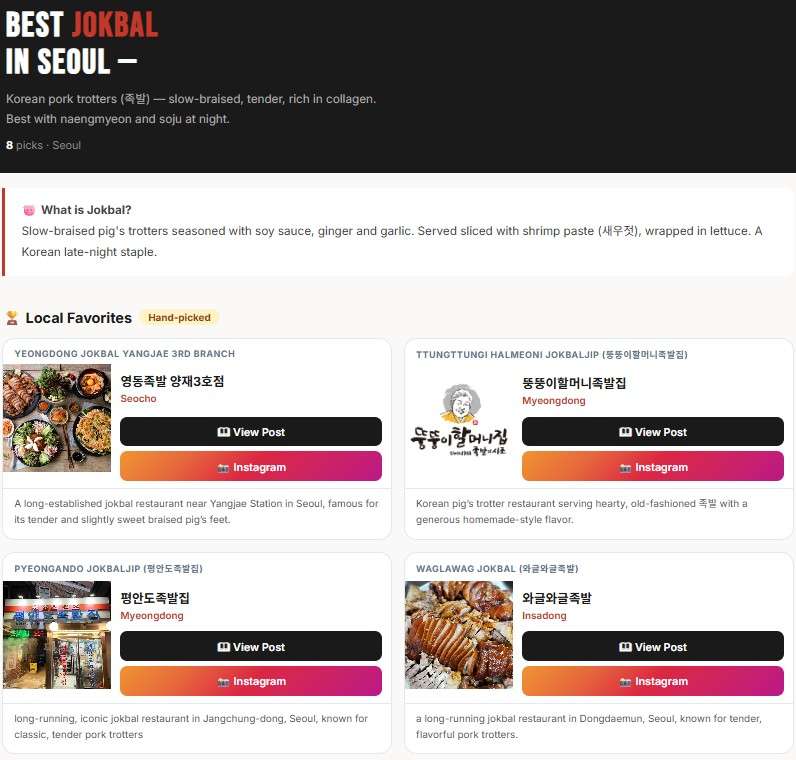
Pyeongando Jokbaljip (평안도족발집): One of the most iconic names on the Jangchung-dong jokbal street. Long-running, old-school atmosphere, classic recipe that has not changed in decades. The skin is exceptionally soft and the flavor is clean — not too sweet, not too salty. Always busy. Expect to wait on weekends.
Ttungttungi Halmeoni Jokbaljip (뚱뚱이할머니족발집): Another Jangchung-dong institution. The name translates roughly to ‘Chubby Grandma’s Pork Trotter House’ — and the food lives up to the warmth that implies. Homemade-style flavor, generous portions, loyal repeat customers.
Gangnam Area
Ribukjip Nonhyeon (리북집 논현본점): Well-known for its cold jokbal (냉족발) — thinly sliced, firm, served chilled with a spicy dipping sauce. A different experience from the classic hot version. Popular with Gangnam office workers for late dinners. Nonhyeon area, near Hakdong Station.
Seocho Area
Yeongdong Jokbal Yangjae 3rd Branch (영동족발 양재3호점): A long-established restaurant near Yangjae Station with a reputation for tender, slightly sweet braised trotters. Consistent quality and a loyal local following. Good option if you are coming from southern Seoul.
Seongsu Area
Seongsu Jokbal (성수족발): Popular with the younger crowd that has moved into Seongsu-dong. Glossy, sweet-savory jokbal with a more contemporary restaurant atmosphere than the old Jangchung-dong spots. Good photos, good food.
Hongdae Area
Manjok Ohyang Jokbal Hongdae (만족오향족발 홍대역점): A well-known franchise with multiple locations. Ohyang (오향) means five-spice — the flavor profile is slightly more aromatic than standard jokbal. Reliable quality and consistent across locations. Good choice if you are in the Hongdae area.
Insadong / Dongdaemun Area
Waglawag Jokbal (와글와글족발): A long-running Dongdaemun area restaurant known for tender, flavorful trotters. The name means ‘bustling’ in Korean and the atmosphere matches — lively, busy, good energy for a late-night meal.
What to Order
Item
Korean
Notes
Small portion
소 (소자)
Serves 1–2, around ₩28,000–₩32,000
Medium portion
중 (중자)
Serves 2–3, around ₩35,000–₩42,000
Large portion
대 (대자)
Serves 3–4, around ₩45,000–₩55,000
Cold noodles
냉면
Essential pairing, ₩10,000–₩13,000
Cold jokbal
냉족발
Chilled version, ask if available
Practical Tips
Jokbal is a late-night food — most restaurants are busiest from 7 PM onwards. Many stay open until midnight or later.
It is designed for sharing — order a medium for two people. A small portion for one is possible but jokbal is better as a shared meal.
Use the scissors — the table scissors are for cutting the meat into smaller pieces if needed. Normal practice.
Soju pairing: Jokbal and soju is the classic combination. The fat in the meat coats the stomach and makes for a gentler drinking experience than drinking on an empty stomach.
Jangchung-dong on weekends: Busy. Go early (6–7 PM) or be prepared to wait.
Jokbal is one of those foods that sounds strange until you actually try it. Braised pig’s trotters does not sound like a compelling dinner option. But the texture — that soft, collagen-rich skin and tender meat — and the combination with cold noodles and a glass of soju on a late Seoul evening is genuinely one of the better eating experiences this city offers. Start with Jangchung-dong if you want the classic version. Go late.