Quick Answer
- What it is: Whole young chicken stuffed with glutinous rice, ginseng, garlic, and jujube — simmered into a rich broth
- Price: ₩15,000–₩22,000 per pot
- When Koreans eat it: Summer — especially on the three hottest days of the lunar calendar (삼복)
- Health claims: Energy recovery, immunity, stamina — taken seriously, not just tradition
- Spice level: None — mild, clean broth
Most foreign visitors expect Korean food to be spicy and bold. Then samgyetang arrives — a pale, quiet bowl with a whole small chicken submerged in clear broth — and it looks almost plain. It is not plain. It is one of the most carefully constructed health dishes in Korean cuisine, built over centuries around the idea that what you eat in summer determines how you survive the heat. Koreans do not eat this because it tastes exciting. They eat it because it works.
What Is Samgyetang?
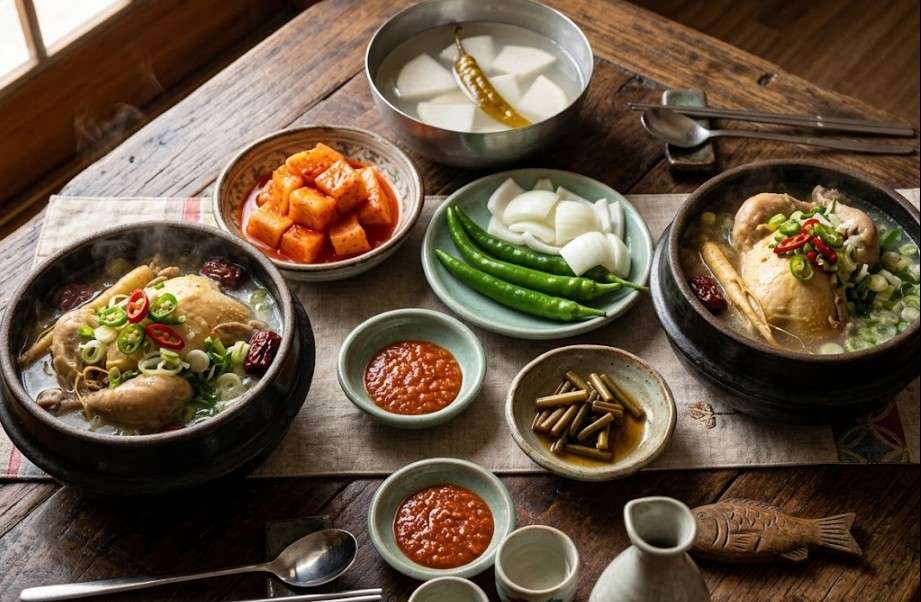
Samgyetang (삼계탕) breaks down literally: sam (삼) means ginseng, gye (계) means chicken, tang (탕) means soup. A young whole chicken — small enough to fit in a single serving pot — is stuffed with sweet glutinous rice, fresh ginseng root, dried jujube (대추), garlic cloves, and sometimes chestnuts or goji berries. The pot is then simmered for hours until the chicken is completely tender and the broth becomes rich and slightly milky.
Each ingredient has a specific purpose in traditional Korean medicine. Ginseng for energy and immunity. Garlic for circulation and antibacterial properties. Jujube for calming the nervous system and supporting blood quality. Glutinous rice to fill and sustain. This is not a dish assembled for flavor alone — it is a formula.
Why Koreans Eat It in Summer
This is the part that surprises most foreigners. Korea’s summers are brutally hot and humid — 35°C+ with high humidity is normal in July and August. The instinct for most people is to eat cold food. Korean traditional medicine takes the opposite view: fighting heat with heat. The logic is that hot food in summer forces the body to sweat properly, improves circulation, and restores the energy lost through sweating. This concept is called “이열치열” (yi-yeol chi-yeol) — fighting fire with fire.
The three hottest days of the lunar calendar — called 초복, 중복, and 말복 (collectively 삼복) — are when samgyetang consumption peaks. On these days, samgyetang restaurants across Korea have queues out the door from lunch onwards. Koreans treat this the way some cultures treat specific holiday foods — it is not just a meal, it is a seasonal ritual.
Dad’s Local Tip: If you are in Korea during 삼복 (usually mid-July to mid-August) and you walk past a samgyetang restaurant with a long queue of office workers at noon — join it. That queue is the recommendation. The places that fill up on 복날 are the ones that have been doing this right for years.
How to Eat It
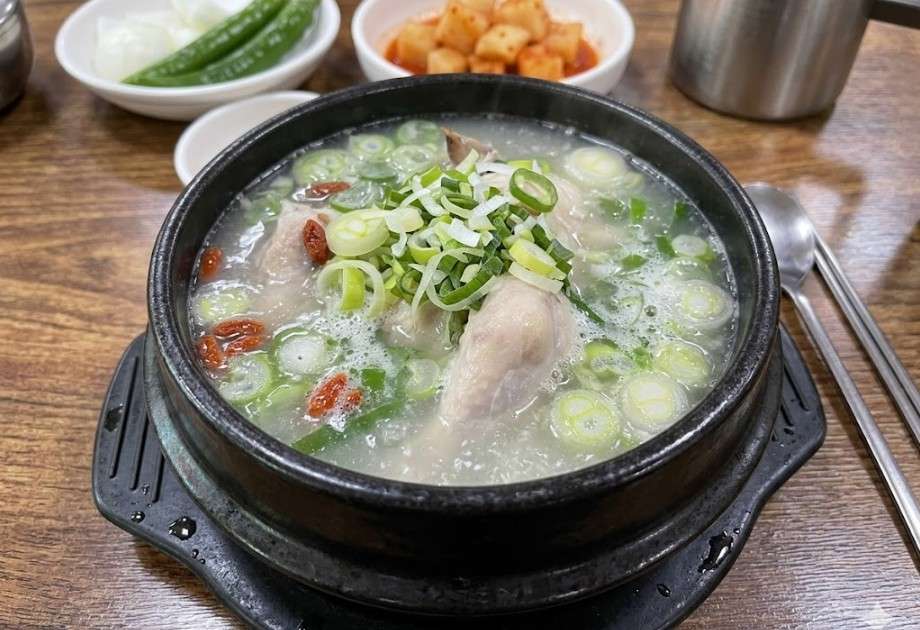
Samgyetang arrives in a stone or ceramic pot, still boiling. The chicken is whole but completely tender — it falls apart with light pressure from your spoon. Here is the standard approach:
- Wait two minutes — the pot is extremely hot. Burns are common with impatient first-timers.
- Season the broth first — salt and pepper are on the table. Add a small amount to the broth and taste before adding more. The broth is intentionally under-seasoned so you control it.
- Break the chicken apart with your spoon and chopsticks — no knife needed. Pull the meat off and eat it with the broth.
- Eat the stuffing — the glutinous rice inside the chicken absorbs the broth and ginseng. This is the most nutritious part and many locals consider it the best bite.
- Chew the garlic cloves — they soften completely during cooking and lose most of their sharpness. Worth eating.
- The ginseng root — eat it or leave it depending on your tolerance. It is bitter. Some people eat it straight, others dip it in salt.
Side dishes typically include kimchi and kkakdugi (diced radish kimchi). The sharpness of kimchi alongside the mild broth is intentional — the contrast works well.
Dad’s Local Tip: Order the 흑삼계탕 (black ginseng samgyetang) if it is on the menu — it uses older, more concentrated ginseng and the broth is noticeably deeper. Costs ₩3,000–₩5,000 more but worth it if you are eating this for the health benefit rather than just the experience.
Samgyetang Variations
| Type | Korean | Difference | Price |
|---|---|---|---|
| Standard | 삼계탕 | Young chicken, fresh ginseng | ₩15,000–₩18,000 |
| Black ginseng | 흑삼계탕 | Aged black ginseng — stronger, more bitter | ₩18,000–₩22,000 |
| Abalone | 전복삼계탕 | Whole abalone added — richer broth | ₩22,000–₩28,000 |
| Hwanggi | 황기삼계탕 | Astragalus root added — traditional immunity boost | ₩17,000–₩20,000 |
| Ogol chicken | 오골계삼계탕 | Black-boned silkie chicken — considered more potent | ₩20,000–₩25,000 |
The Health Case — What the Science Says
Korean traditional medicine has used ginseng for over 2,000 years as an adaptogen — a substance that helps the body manage stress and maintain equilibrium. Modern research has produced evidence supporting several of these traditional claims. Ginsenosides, the active compounds in ginseng, have been studied for their effects on immune function, fatigue reduction, and anti-inflammatory response.
Bone broth — which samgyetang essentially is — has attracted significant Western health attention in recent years for its collagen content and gut health benefits. Koreans have been eating this version of it for centuries without needing the trend. The combination of slow-cooked collagen-rich broth, ginseng, garlic, and jujube makes samgyetang one of the more nutritionally dense single-dish meals in any cuisine.
Whether you believe in traditional medicine or not, the practical reality is this: samgyetang is high protein, warming, and genuinely restorative after physical exertion, illness recovery, or a difficult day. It does what it claims to do.
Where to Eat Samgyetang in Seoul
Samgyetang restaurants are everywhere in Korea but quality varies significantly. The best ones use fresh whole chickens (not frozen), real ginseng root (not powder or extract), and simmer each pot individually rather than batch-cooking.
Insadong and Bukchon area: High concentration of well-regarded samgyetang restaurants, many with decades of history. Slightly tourist-facing but the quality is genuine — these places have reputations to protect.
Dongdaemun area: More local, less polished. The restaurants here feed the market workers and neighborhood residents — consistent quality without the tourist markup.
Anywhere near a traditional market: Samgyetang restaurants cluster near traditional markets across Korea. The logic is simple — the ingredients come from the same suppliers. Freshness is generally better here than near tourist landmarks.
Samgyetang vs Baeksuk — What’s the Difference?
Baeksuk (백숙) is the simpler version — whole chicken simmered in water with garlic and green onion, without the stuffing. It predates samgyetang and is considered the base form. Samgyetang is baeksuk elevated with ginseng and the stuffed rice. Baeksuk is cheaper (₩12,000–₩16,000), milder in flavor, and sometimes preferred by people who find ginseng too bitter. If a restaurant serves both, the samgyetang is almost always worth the extra ₩2,000–₩3,000.
Daddy’s Final Note
I eat samgyetang when I am tired, when I have been sick, or on the first seriously hot day of summer. Not because tradition tells me to — because it reliably makes me feel better for the rest of the day. There is a reason this dish has survived unchanged for centuries while food trends come and go. It is not complicated food. It is effective food. If you are in Korea for more than a week, eat it once. Pick a place with Korean customers, order the standard version first, season it properly with salt, and eat the stuffing. You will understand why Koreans treat this as medicine.