Quick Answer
- Is Korea good for families? Yes — genuinely one of the most family-friendly countries in Asia
- Best age group: Works well for all ages — toddlers to teenagers
- Biggest challenge: Food for picky eaters and managing long days on the subway
- Best base: Hongdae or Myeongdong — central, convenient, easy to navigate
Korea is an excellent country to travel with kids. That is not a promotional statement — it is a practical observation from someone who lives here and has watched hundreds of foreign families navigate it. The public transport is stroller-friendly, the food options are wide, the attractions are genuinely interesting for children, and Koreans are exceptionally warm toward foreign kids. Here is the honest version of what to expect.
Getting Here With Kids
Incheon International Airport consistently ranks among the best airports in the world for families. Dedicated children’s play zones are located in both terminals — useful for burning energy before or after long flights. Stroller rental is available at the airport if you need one temporarily. The airport is large but well-organized with clear English signage throughout.
From the airport to Seoul with kids: The Airport Limousine Bus is the most practical option with children — it drops you near major hotels without subway transfers, has luggage space, and does not require navigating stairs with a stroller. The AREX Express is faster but involves stairs and transfers at Seoul Station. For families with young children or significant luggage, spend the extra money on a taxi or limousine bus.
Car seats: Korean taxis are not required to provide car seats. If you need one, book a family taxi through Kakao Taxi (select the family option) or rent a car with a car seat included. For families with infants, this is worth planning in advance.
Getting Around Seoul With Kids
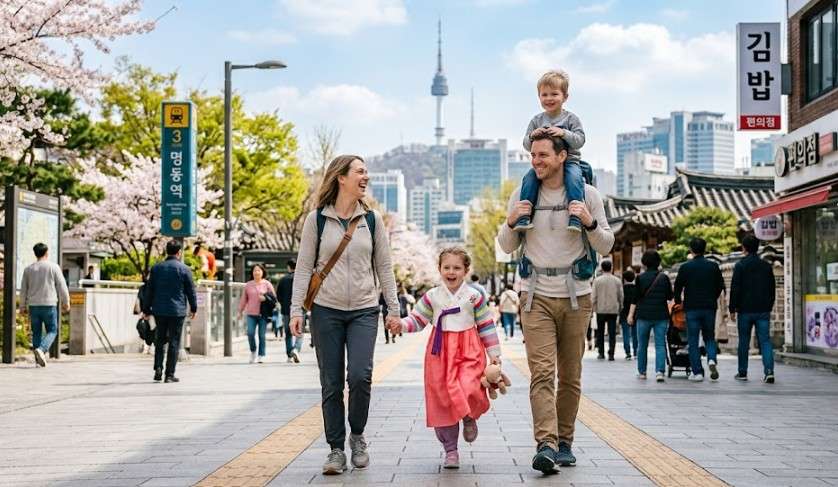
Seoul’s subway is extensive but involves stairs and long walking distances between exits. For families with strollers:
- Every station has elevators — but finding them takes navigation. Use Naver Map and select the accessibility route option to get directions that route you through elevators automatically.
- Strollers are allowed on the subway. Fold them during rush hour (7-9 AM, 6-8 PM) as a courtesy — trains are packed and an open stroller blocks the aisle.
- Children under 6 ride free on Seoul Metro. Ages 6-12 pay a child fare.
Taxis are often easier than the subway with young children. A short taxi ride costs ₩4,000-₩8,000 and gets you door to door without stairs, transfers, or navigating a crowded platform with a stroller. Use Kakao Taxi for transparent pricing and card payment.
T-money card: Buy one for each child who needs to pay fare. Load with ₩10,000-₩20,000. Tap on and off at every subway gate and bus door — the system handles child fares automatically if you register the card as a child card at a convenience store.
Food With Kids in Korea
Korean food works well for most children — the flavors are varied enough that even picky eaters find something. The challenge is spice level. Many Korean dishes contain gochujang (red chili paste) and can be surprisingly hot for young palates.
Safe Bets for Picky Eaters
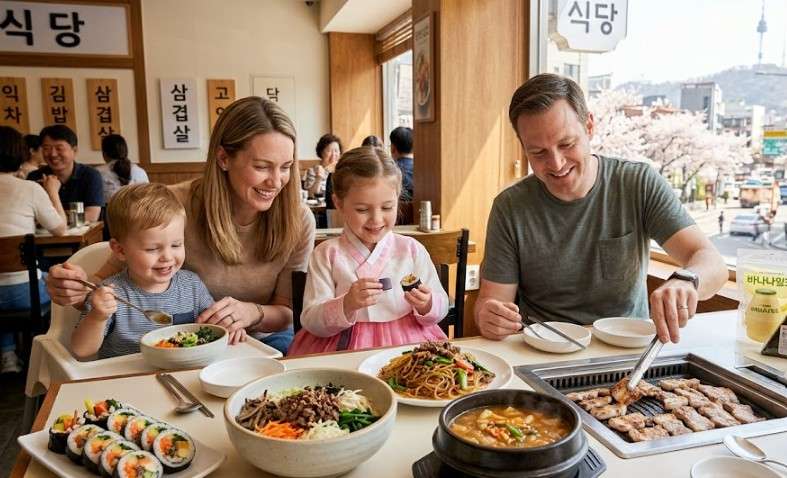
- Kimbap (김밥): Rice rolls with mild fillings — egg, cheese, tuna, vegetables. Available everywhere, inexpensive, universally liked by children. The cheese kimbap variety is particularly popular with kids.
- Bibimbap (비빔밥): Ask for it without gochujang (고추장 빼주세요) and it becomes a mild rice and vegetable bowl. Most restaurants accommodate this without issue.
- Japchae (잡채): Glass noodles with vegetables and beef. Mildly sweet, not spicy. Most children enjoy it.
- Samgyeopsal (삼겹살): Korean BBQ pork belly — the grilling process is interactive and children tend to love the experience. Not spicy unless you add the sauce.
- Doenjang jjigae (된장찌개): Soybean paste stew — mild, savory, comes with rice. A reliable non-spicy option at most Korean restaurants.
- Convenience store food: Korean convenience stores (GS25, CU) carry triangle kimbap, steamed buns, banana milk, and corn dogs that children consistently enjoy. Useful for quick meals between activities.
What to Avoid for Young Children
- Tteokbokki (spicy rice cakes) — very spicy, not suitable for young children
- Kimchi jjigae — spicy stew
- Any dish labeled 매운 (maewun) — means spicy
- Street food labeled 불닭 (fire chicken) — extremely spicy
Useful Phrase
“안 매운 걸로 주세요” (an maewun geol-lo juseyo) — “Please give us something not spicy.” Show this to restaurant staff on your phone if pronunciation is uncertain.
Best Family-Friendly Attractions in Seoul
Gyeongbokgung Palace (경복궁)
The largest Joseon Dynasty palace in Seoul. Children enjoy the scale of the buildings, the changing of the royal guard ceremony (매일 10AM and 2PM except Tuesday), and the option to rent hanbok (traditional Korean clothing) from shops at the entrance gates — dressed in hanbok, children get free palace entry. Allow 1.5-2 hours. Entry ₩3,000 for adults, free for children under 6.
National Museum of Korea (국립중앙박물관)
One of the best museums in Asia and completely free. The children’s museum section inside is specifically designed for ages 3-12 with hands-on exhibits about Korean history and culture. The main museum has an impressive scale that holds older children’s attention well. Located in Yongsan — subway Line 4 or Jungang Line to Ichon Station.
Seoul Children’s Grand Park (서울어린이대공원)
A large park in eastern Seoul with a zoo, botanical garden, amusement rides, and open green spaces. Entry to the park is free — individual attractions have small fees. Popular with Korean families on weekends. Takes a full day. Subway Line 7 to Children’s Grand Park Station.
Lotte World (롯데월드)
Indoor and outdoor theme park in Jamsil. The indoor section operates year-round regardless of weather — particularly useful in summer heat or winter cold. Popular rides for children of all ages. Expect queues on weekends and Korean school holidays. Day pass around ₩62,000 for adults, ₩49,000 for children. Subway Lines 2 and 8 to Jamsil Station.
Han River Parks (한강공원)
Free, open, and excellent for children who need to run around. Rent bikes or four-wheeled pedal carts (the family version is popular). Bring food from a nearby convenience store and join the Koreans picnicking on the grass. Best parks for families: Yeouido (Line 5, Yeouinaru Station) and Ttukseom (Line 7, Ttukseom Resort Station).
Trick Eye Museum (트릭아이뮤지엄) — Hongdae
Interactive 3D illusion art museum where visitors become part of the artwork. Hugely popular with children and teenagers — every exhibit is designed to be photographed. Located in Hongdae. Entry around ₩15,000. Usually 1-1.5 hours inside.
COEX Aquarium (코엑스 아쿠아리움)
Large aquarium inside COEX Mall in Gangnam. Around 650 species of marine life. Tunnel walkways, shark tank, touch pool for younger children. Entry ₩29,000 for adults, ₩24,000 for children. Allow 1.5-2 hours. Combined with COEX Mall makes a full day activity regardless of weather.
Day Trips With Kids
Everland (에버랜드): Korea’s largest theme park, about 1 hour from Seoul by shuttle bus from Gangnam. Full day activity. Zootopia section popular with younger children. Seasonal events — tulip festival in spring, Halloween in October. Day pass ₩62,000 adults, ₩52,000 children.
Suwon Hwaseong Fortress: 1 hour by subway from Seoul. The fortress walls are walkable and the scale is impressive for children. The Suwon folk village inside the fortress area has traditional demonstrations. Combine with Haengridan-gil cafes for a full family day out.
Nami Island (남이섬): Tree-lined paths, open green spaces, and a relaxed atmosphere that works well for families. The ferry crossing is a highlight for younger children. About 1.5 hours from Seoul by train and ferry.
Practical Family Tips
Baby and toddler supplies: Korean convenience stores and supermarkets (Emart, Lotte Mart) carry diapers, formula, baby food, and wipes at prices similar to or lower than Western countries. No need to pack excessive supplies — restock locally.
Stroller-friendly streets: Major tourist areas are generally paved and manageable. Traditional neighborhoods like Bukchon Hanok Village have steep, uneven stone paths that are difficult with strollers — consider a carrier for young children in these areas.
Breastfeeding: Korea has nursing rooms (수유실) in most major shopping malls, department stores, museums, and subway stations. Look for the nursing room sign or ask staff. Public breastfeeding is generally accepted without issue in most settings.
Medical care: Korea’s medical system is excellent and affordable. For minor illness, the pharmacy (약국) is the first stop — Korean pharmacists are experienced and helpful. For anything more serious, major hospitals in Seoul have international patient centers with English-speaking staff. Bring travel insurance that covers children.
Koreans and foreign children: Koreans are genuinely warm toward children, particularly foreign children. Expect attention, smiles, and occasional small gifts of sweets from older Koreans. This is normal and well-intentioned — not something to be alarmed about.
High chairs and baby facilities: Family restaurants and larger chains generally have high chairs. Smaller local restaurants may not — bring a portable travel high chair if your child requires one. Baby changing facilities are available in most shopping malls and tourist attractions.
Best Accommodation for Families
Look for apartments or serviced residences rather than standard hotel rooms for stays longer than 3 nights — kitchen access makes meal management significantly easier with children. Airbnb has good family apartment options in Hongdae, Mapo, and Gangnam.
If staying in a hotel, request a connecting room or family room specifically — Korean hotel rooms are often compact by international standards. Major chains (Lotte, Shilla, Marriott) have family room configurations available.
Sample 3-Day Family Itinerary
| Day | Morning | Afternoon | Evening |
|---|---|---|---|
| Day 1 | Gyeongbokgung Palace + hanbok rental | National Museum of Korea (free) | Korean BBQ dinner |
| Day 2 | Han River Park — bikes and picnic | Lotte World or Trick Eye Museum | Convenience store dinner + night walk |
| Day 3 | Suwon Hwaseong Fortress day trip | Haengridan-gil cafes | Suwon galbi dinner |
Daddy’s Final Note
Korea is one of the easiest countries in Asia to travel with children. The infrastructure works, the food has enough variety, the people are kind, and there is enough to do that even teenagers stay engaged. The main adjustment is pace — Korean cities move fast and the days can be long. Build in rest time, keep the itinerary flexible, and do not try to see everything. The families that enjoy Korea most are the ones that slow down enough to actually experience it rather than just photograph it.