Quick Answer
- From Seoul: 1 hour by subway (Airport Railroad or Line 1 to Incheon Station)
- What it is: Korea’s only Chinatown + preserved Japanese colonial open-port district side by side
- Cost: Transport + food — full day under ₩30,000
- Best for: History, architecture, jajangmyeon, and escaping Seoul crowds
- Time needed: 4–6 hours for a complete visit
Most foreign visitors pass through Incheon twice — arriving and leaving through the airport — without ever seeing the city itself. That is understandable and also a genuine miss. The area around Incheon Station contains Korea’s only functioning Chinatown, a preserved Japanese colonial open-port district, and some of the best jajangmyeon in the country, all within 15 minutes walk of each other. It takes one hour from Seoul and costs almost nothing to get there.
Why Incheon Has a Chinatown
Incheon (then called Jemulpo) was Korea’s first port opened to foreign trade under the 1882 Treaty of Chemulpo. Chinese, Japanese, and Western merchants established concession areas in the city — designated zones where foreign nationals lived and operated under their own legal jurisdictions. The Chinese concession became what is now Incheon Chinatown. The Japanese concession became Gaehangro (개항로) — the open-port road district.
This history makes Incheon architecturally unusual. Within a few hundred meters you can walk from Chinese-style gate architecture to preserved Japanese colonial banking buildings to early Western consulate structures. Nowhere else in Korea has this compressed layering of the late 19th-century treaty port period.
Incheon Chinatown (인천 차이나타운)
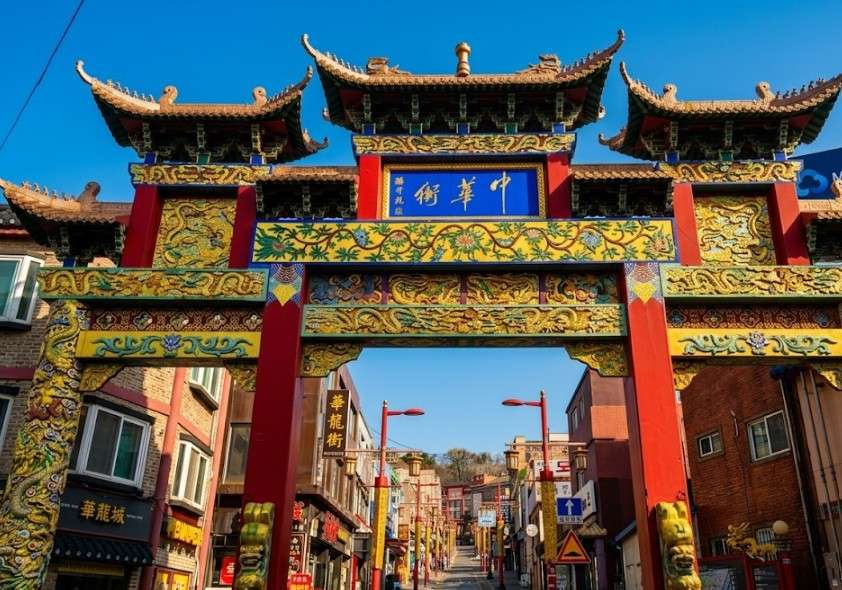
Korea’s only official Chinatown is smaller than the name suggests — roughly four to five streets radiating from the Paeruimun gate at the top of the hill near Incheon Station. It is genuinely Chinese-Korean rather than a theme park version — the community has been here since the 1880s and the restaurants are operated by families with generations of history in the area.
The architecture is a mix of Chinese-style painted buildings, murals depicting Korean-Chinese history, and older structures dating to the early 20th century. It is compact enough to walk completely in 30–40 minutes but worth spending longer if you eat here.
What to eat in Chinatown:
- Jajangmyeon (자장면) — black bean paste noodles, the dish most associated with Incheon Chinatown. This is where jajangmyeon was introduced to Korea in the late 19th century. The version here uses a chunkier, less sweet sauce than the Seoul convenience versions. Order it at one of the older family-run restaurants, not the large tourist-facing places near the gate.
- Jjamppong (짬뽕) — spicy seafood noodle soup, equally associated with Korean-Chinese cuisine. Order both and share if you are with someone.
- Gong Gal Tang (공갈빵) — large hollow Chinese-style bread, crispy outside and almost entirely air inside. A Chinatown snack with no nutritional value and considerable entertainment value.
Dad’s Local Tip: Jajangmyeon in Incheon Chinatown tastes different from what you get in Seoul or at chain restaurants — the sauce is darker, less sweet, and more fermented in character. This is the original version. If you have only eaten jajangmyeon from delivery apps, eating it here will recalibrate your understanding of the dish.
Gaehangro Open-Port District (개항로)
Walk through the Chinatown gate and down the hill toward the waterfront and you enter Gaehangro — the preserved Japanese colonial district from the open-port period. This area has been carefully maintained and partially restored as a living historic district, with the original 1880s–1930s architecture still intact along the main street.
Key buildings:
- Incheon Open Port Museum (인천개항박물관) — housed in the original 1883 Japanese First Bank building. Small but well-curated — explains the treaty port history clearly. ₩500 entry.
- Japan First Bank Building (제1은행) — one of the oldest Western-style buildings in Korea, built 1888. The exterior is intact and striking.
- Incheon Art Platform (인천아트플랫폼) — a cluster of early 20th-century Japanese warehouse buildings converted into artist studios and gallery spaces. Free entry to the courtyard. Worth walking through.
The street itself has developed a café culture over the past decade — independent coffee shops and restaurants have opened in the historic buildings, creating the same preserved-building-meets-café aesthetic that Haengridan-gil in Suwon has. Less developed and less crowded than most Seoul equivalents.
Jayu Park (자유공원)
The hill above Chinatown contains Jayu Park — the first Western-style public park in Korea, established in 1888. The park has a large statue of General Douglas MacArthur commemorating the Incheon Landing of 1950, which turned the Korean War. The views over the port and toward the sea are good on clear days. Worth 20–30 minutes if you are already in the area.
Dad’s Local Tip: Come on a weekday. Incheon Chinatown on weekends — especially in spring and autumn — gets busy with Korean domestic tourists. On a Tuesday or Wednesday, you can walk the Gaehangro district almost alone and get a table at the best jajangmyeon restaurants without waiting.
Suggested Route
This covers the main areas comfortably in 4–5 hours:
- Arrive at Incheon Station (subway) → walk to Chinatown gate (5 minutes)
- Walk Chinatown streets — 30–40 minutes
- Lunch at a Chinatown restaurant — jajangmyeon or jjamppong (45–60 minutes)
- Walk to Jayu Park — views over the port (20–30 minutes)
- Descend to Gaehangro — walk the main street, visit Open Port Museum (60–90 minutes)
- Coffee at one of the Gaehangro café buildings (30 minutes)
- Walk back to Incheon Station — subway back to Seoul
Getting There
From Seoul Station: Airport Railroad (AREX) to Incheon Station — approximately 60 minutes, ₩4,150. This is the most direct route.
From Hongdae or Sindorim: Line 1 direct to Incheon Station — approximately 70–80 minutes. Slightly longer but convenient if you are based in western Seoul.
From Incheon Airport: If you have a layover of 4+ hours, Incheon Station is 30 minutes from the airport by AREX. A layover visit to Chinatown and back is entirely feasible — leave luggage at the airport storage.
Dad’s Local Tip: The airport layover option is underused. If you have a 5–6 hour layover at Incheon Airport, taking the AREX to Incheon Station, eating jajangmyeon in Chinatown, walking Gaehangro for an hour, and returning is a better use of time than sitting in the terminal. Factor in 30 minutes each way and 30 minutes buffer for check-in — you need at least 4.5 hours total layover time to do this comfortably.
Practical Information
| Detail | Information |
|---|---|
| Subway to Incheon Station | ₩4,150 from Seoul Station (AREX) |
| Jajangmyeon price | ₩8,000–₩12,000 per bowl |
| Open Port Museum entry | ₩500 |
| Jayu Park entry | Free |
| Best season | Year-round — covered areas make it viable in rain |
| Nearest station | Incheon Station (Line 1 / AREX) |
Daddy’s Final Note
Incheon gets overlooked because the airport is there and people assume the city is just infrastructure. The area around Incheon Station tells a different story — 140 years of treaty port history compressed into a walkable neighborhood, with the best jajangmyeon in Korea available for ₩10,000. One hour from Seoul, almost no foreign tourists, and a legitimate half-day of things worth seeing. If you are spending more than four days in Korea and you have not been, go. Take the AREX, eat in Chinatown, walk Gaehangro, come back. It costs almost nothing and changes how you understand what Korea looked like when the rest of the world first arrived here.