Quick Answer
- First step: Buy a T-money card at any convenience store — ₩3,000
- Best app: Naver Map (not Google Maps — incomplete data in Korea)
- Subway hours: Approximately 5:30 AM – midnight
- After midnight: Kakao Taxi or night owl buses
- Transfer discount: Bus to subway (or bus to bus) within 30 minutes — automatic with T-money
This seoul public transport guide covers everything a first-time visitor needs to get around confidently. Seoul’s public transport works well — the subway is clean, on time, and goes everywhere. The buses fill in the gaps. Once you understand a few basics, getting around is genuinely easy.
Seoul Public Transport: All Options at a Glance
| Option | Best For | Cost | Hours |
|---|---|---|---|
| Subway (지하철) | Most destinations, fast | ₩1,400–₩2,000 | 5:30 AM – midnight |
| Blue Bus (간선버스) | Long routes across city | ₩1,400–₩1,800 | 24 hours (some) |
| Green Bus (지선버스) | Local neighborhood routes | ₩1,200–₩1,500 | Daytime |
| Red Bus (광역버스) | Seoul to surrounding cities | ₩2,400–₩3,000 | Daytime |
| Night Bus (올빼미버스) | After midnight | ₩2,400 | Midnight – 5 AM |
| Kakao Taxi | Late night, convenience | Metered | 24 hours |

Step 1 — Get a T-money Card First
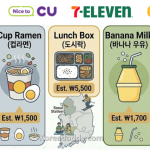
Before anything else in this seoul public transport guide: get a T-money card. You can buy one at any convenience store (CU, GS25, 7-Eleven) for ₩3,000 — that’s just the card, not the credit. Load it up at the same counter and you’re done. Tap in, tap out, the fare is deducted automatically.
Using a T-money card is slightly cheaper than buying individual tickets, and you don’t have to figure out the ticket machine every time you enter a station. Worth the five minutes it takes to sort out on your first day. A good starting balance is around ₩10,000 — just ask the clerk to “top up” or “recharge” the card after you buy it.
T-money also works for: buses, taxis, some convenience store purchases, and Han River ferry. One card covers almost all transport in Seoul.
How to Use the Seoul Subway
The Seoul subway has 9 main lines plus several additional lines covering the greater Seoul area. Lines are color-coded and numbered — Line 2 (green), Line 4 (blue), Line 9 (gold), and so on. Most tourist destinations are within easy reach of Line 2, which forms a loop around central Seoul.
The Exit Number Matters
Seoul subway stations are large and exits are spread over a wide area. Getting off at the right station but the wrong exit can mean a 10-minute walk in the wrong direction. Always check which exit number you need before you get off. Naver Map shows this automatically when you use it for directions.
Transferring Between Lines
Transfers between subway lines within the same station are free — tap out and tap back in at the transfer gate. Transfers between subway and bus are discounted if done within 30 minutes. The T-money card handles all of this automatically — you don’t need to do anything except tap correctly.
How to Use Seoul Buses
A lot of visitors stick to the subway and ignore buses. That’s fine, but buses often go more directly to where you’re going and the routes are less confusing than they look.
- Blue buses (간선버스): Long-distance routes across the city — fast, frequent, main corridors
- Green buses (지선버스): Local neighborhood routes — connect residential areas to subway stations
- Red buses (광역버스): Connect Seoul to surrounding cities — Suwon, Incheon, Bundang
- Yellow buses (순환버스): Short circular routes within specific districts
Tap your T-money card when you get on and again when you get off. If you’re transferring between bus and subway within 30 minutes, you get a transfer discount automatically.
Naver Map — Not Google Maps
Google Maps has incomplete transit data for Korea due to mapping restrictions. Naver Map has everything — exact bus numbers, subway lines, walking directions, and live arrival times. It works in English. Use it for all navigation in Seoul.
Download Naver Map before you arrive. Set your language to English in the app settings. When searching for directions, select “Public Transit” and Naver Map shows every option with exact times, transfer points, and exit numbers.
After Midnight — Late Night Options
The subway stops around midnight. After that, two options:
Night owl buses (올빼미버스): Run on 9 routes through central Seoul from midnight to 5 AM. Numbered N10 through N99. Fare is ₩2,400 with T-money. Routes are shown on Naver Map.
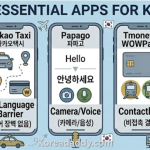
Kakao Taxi: The easiest option after midnight. Download the app before you need it. Enter your destination in English — the app translates it automatically. Most drivers do not speak English but the app handles communication. Set your pickup and destination in advance if you’re somewhere unfamiliar.
Priority Seats — Important for First-Time Visitors
Subway seats marked in purple or dark blue near the doors are priority seats for elderly, pregnant, and disabled passengers. These are taken seriously in Korea — do not sit in them even if the car is empty. It is a cultural expectation, not just a suggestion. Standing next to an empty priority seat is completely normal.
Practical Tips
- Keep ₩5,000–₩10,000 loaded on your T-money card at all times — recharge at any convenience store
- Rush hour (7:30–9 AM, 6–8 PM) on Line 2 and Line 9 is genuinely packed — if possible, avoid
- Subway carriages have air conditioning in summer and heating in winter — bring a light layer in summer
- Most stations have elevators and escalators — look for accessibility signs if you have luggage
- Eating and loud phone calls on the subway are considered rude — keep it quiet
Daddy’s Final Note
The seoul public transport guide advice that actually matters: buy the T-money card on day one, download Naver Map before you land, and check the exit number before you get off the subway. Those three things solve 90% of first-timer navigation problems in Seoul. The rest figures itself out quickly — the system is well-designed and forgiving once you understand the basics.